
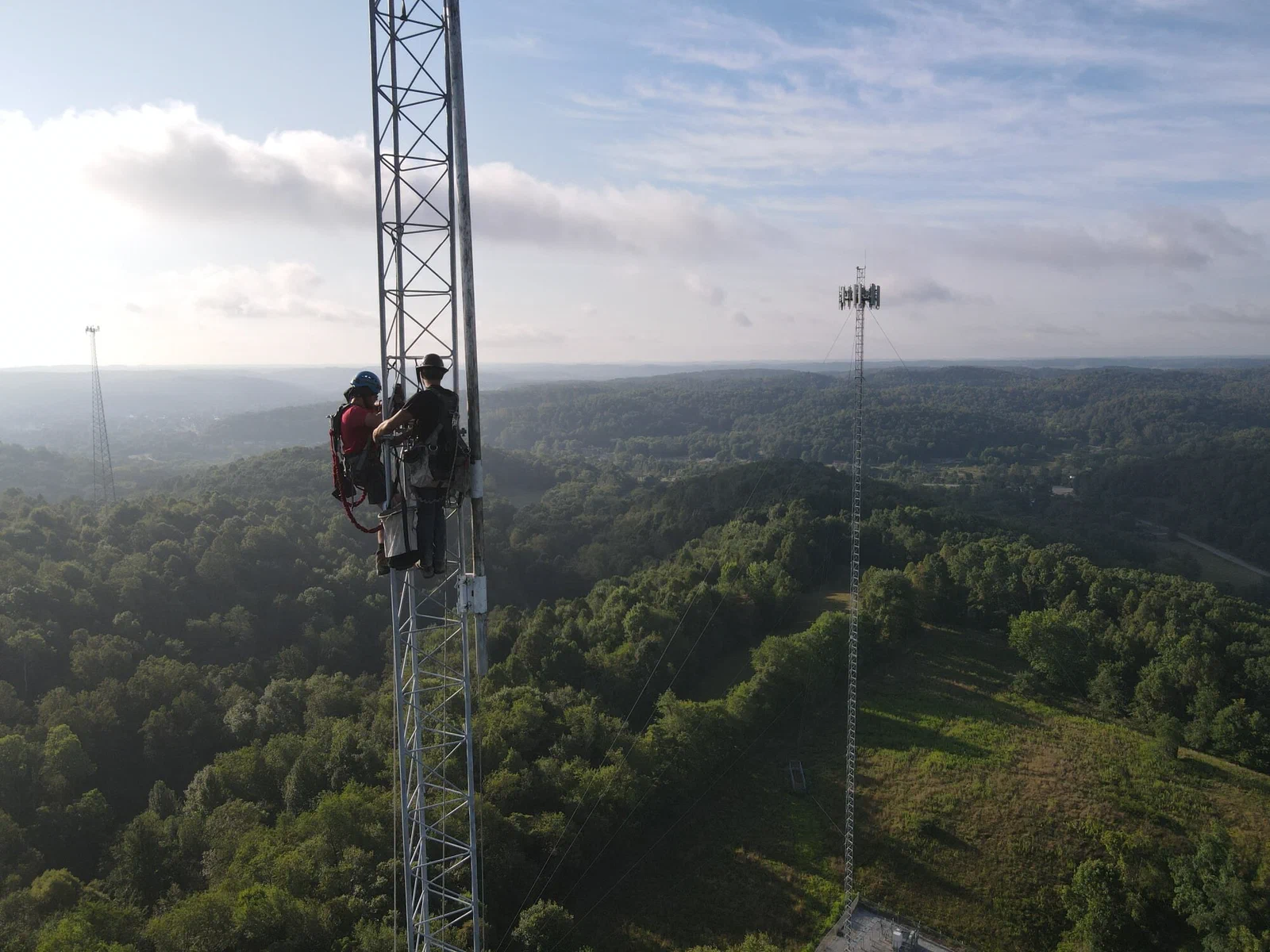
Safety isn't a line item.
It's how we keep the crew.
Every Vertical Axis crew member completes 60+ courses through OWYN Safety before stepping on a site. OSHA Focus Four, fall protection, rescue, equipment operation, exposure hazards, and site programs. Documented, auditable, and current, because carrier landlords, federal programs, and your own engineer are all going to ask for it.
Why we take this seriously.
Safety on a WISP or carrier site isn’t the same as safety on a warehouse floor. The work is at height, next to live RF, on steel somebody else owns. Here’s why that shapes how we run the program.
Carrier landlords demand it.
Every major tower landlord (Tillman, Crown Castle, SBA Communications, American Tower, Vertical Bridge) and every big-five carrier requires a full safety packet on file before a crew is cleared to climb. That means current OSHA 10 or 30, SafetyLMS climbing and rescue certifications, authorized climber rescue on the crew, a documented site-specific JHA, and proof of 100% tie-off policy. Miss one cert and the gate stays locked.
On WISP projects that co-locate on carrier-owned steel, this is where most non-specialist contractors fall out. We stay ahead of it by running every crew member through the full OWYN catalog annually, refreshed on task triggers, and keeping a centralized certification roster that matches any landlord packet format in under a day.
Federal programs audit it.
BEAD, ReConnect, and FirstNet-adjacent work trigger federal documentation requirements on the contractor side. Davis-Bacon-adjacent programs, NHPA Section 106 reviews, and FCC environmental (NEPA) work all add documentation layers. Weekly certified payroll, daily safety logs, JHAs, near-miss reports, and signed toolbox-talk rosters become part of standard delivery, not an exception.
A safety program that’s already built for audit-ready output means those requirements don’t slow the project down. They just get met.
The work itself demands it.
Tower work is climb, rig, torque, cadweld, and align. At 300 feet. In the rain. Next to live RF. One bad ground, one unsecured bolt, one unseen carrier-active sector is the event you don’t walk back from.
Training and habit are what keep the bad day from being the last day. We’d rather over-train on a Monday than under-train on a Tuesday.
Delivered through OWYN Safety.
What every crew member completes.
60+ courses across seven domains. OSHA and industry-standard curriculum, delivered through OWYN Safety’s LMS and refreshed on an annual or task-specific cadence.
Climbing, fall protection, and rescue
The tower-specific core. Every climber refreshes this before the season.
- Fall Protection on Communication Towers
- Dropped Object Prevention
- Rigging for Material Handling
- Overhead Hoist
- Ladder Safety
- Scaffolds
- Manual Lifting
- Slips, Trips, and Falls
OSHA Focus Four
Falls, struck-by, caught-in/between, and electrocution, the four hazards OSHA tracks as construction’s leading fatalities.
- Focus Four: Fall Hazards
- Focus Four: Struck-By Hazards
- Focus Four: Caught-In or -Between Hazards
- Focus Four: Electrocution Hazards
Personal protection and exposure
PPE program and exposure awareness for every hazardous material a tower crew can encounter on a site.
- Personal Protective Equipment: Construction
- Personal Protective Equipment: General Industry
- Personal Protective Equipment for Voluntary Use
- PPE Safety Meeting
- Respiratory Protection
- Noise Exposure and Hearing Conservation
- Bloodborne Pathogens
- First Aid Awareness
- Asbestos Awareness
- Benzene Awareness
- Ammonia Awareness
- Lead Awareness
- Silica Exposure
- Hydrogen Sulfide (H2S) Awareness
Equipment operation
Operator training on every piece of gear on the trailer.
- Aerial Lifts
- Scissor Lifts
- Forklift Operator
- Skid Steer Loaders
- Hand and Power Tools
- Abrasive Wheels
- Box Cutters and Sharp Hand Tools
- Welding, Cutting, and Hot Works
Electrical, RF, and arc
For work near live electrical and RF, including co-located carrier sectors.
- NFPA 70E
- Arc Flash Safety Meeting
- Lockout / Tagout
- GFCI and Assured Grounding
- Non-Ionizing Radiation Hazards
Environmental and hazardous materials
Weather, chemical, and confined-space hazards that apply on tower sites.
- Heat Illness Prevention
- Heat Illness Prevention: Indoor (California)
- Heat Illness Prevention: Outdoor (California)
- Cold Stress Prevention
- Wildfires
- Hazard Communication
- Process Safety Management
- Permit-Required Confined Spaces
- General Waste Management
- Spill Prevention and Response
Program, process, and incident response
Orientation, program management, and how a crew responds when something goes wrong.
- Workplace Safety Orientation: Construction
- Workplace Safety Orientation: General Industry
- A Safe Workplace Safety Meeting
- Accident Prevention Safety Meeting
- Stop Work Authority
- Risk Assessment and Hazard Identification
- Incident Investigation
- Subcontractor Management Plan
- Traffic Control and Work Zone Safety
- Workplace Violence Prevention (California)
Common questions.
What's the baseline for a Vertical Axis crew member?
How do you handle carrier landlord safety packets?
Do you meet Davis-Bacon and federal safety documentation standards?
Who runs your safety program?
What if a specific scope isn't covered by the standard program?
Can you provide certifications to our PM or site inspector?
Your PM or landlord asking for paperwork?
Send the landlord template or project spec. We’ll match the crew, the certifications, and the documentation to what they’re looking for.