
Foundations & Civil: Tower Foundations, Excavation, Rebar & Concrete
Rock-solid tower foundations and everything dirt-related. The work nobody sees, that decides whether a tower stands for 30 years or 30 months. Drilled piers, spread footings, guy anchors, grading, access roads, fencing, and bonded ground rings. All in-house.
What's included.
Everything it takes to get a site ready for steel. Civil, excavation, foundation, and finish work under one scope of work, run by one Vertical Axis crew.
- Site walk, access evaluation, and soils review coordination
- Land clearance, tree removal, and stump grinding
- Site grading, drainage, and silt-fencing to local stormwater spec
- Access-road construction: base rock, geotextile fabric, crown and shoulder
- Excavation for drilled piers, mat foundations, and guy anchors
- Rebar cage fabrication on-site, tied to stamped drawings
- Form setting for stem walls, pedestals, and mat footings
- Concrete supply coordination and 4,000–5,000 PSI pours per engineered spec
- Slump, air-entrainment, and cylinder testing coordination with your inspector
- Ground ring install: bare copper, exothermic welds, bonded before backfill
- Backfill, compaction to spec, and grade finishing
- Weed mat, crushed-stone compound surfacing, and site cleanup
- Compound fencing, swing gates, and barbed-wire top rail
- Bollards, cable-tray trenching, and pad pours for cabinets or generators
- As-built grade survey and handover documentation
Need foundations & civil: tower foundations, excavation, rebar & concrete on a real deadline?
Send your site details. We come back with a quote, a crew, and a schedule.
Foundation work is where sites live or die.
Every problem a tower can have twenty years into its life was either caused by, or prevented by, what happened in the hole. A rebar cage tied sloppy. Concrete short-poured or over-watered on the truck. An access road that washed out the first time it rained hard.
We run civil and foundations in-house because we don’t want those decisions happening in someone else’s crew cab. Our foreman works hand in hand with the construction management team on concrete truck timing, inspector coordination, and grade walk-throughs. That’s how tower foundations are supposed to work.
What a spec-pour actually looks like.
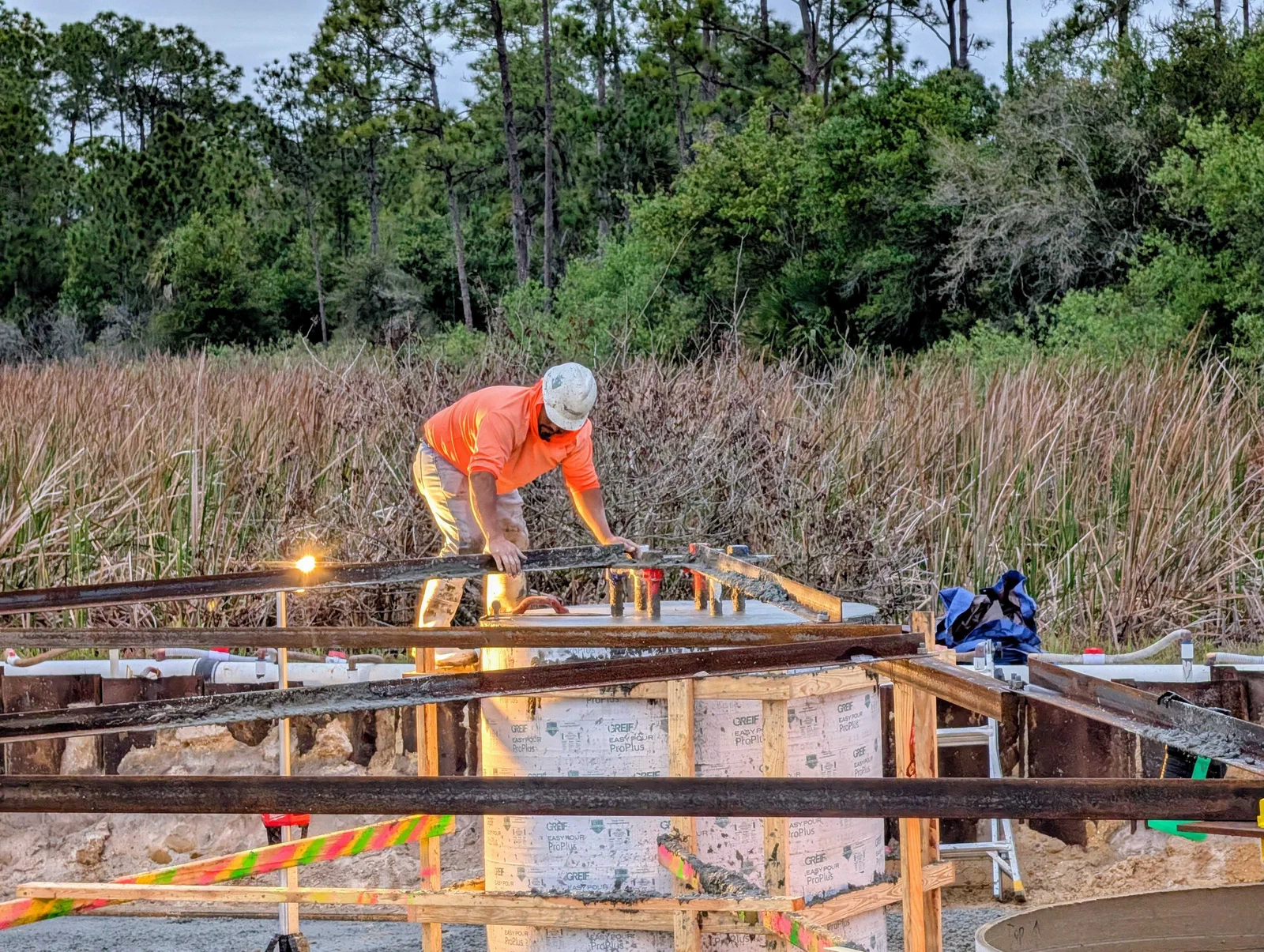
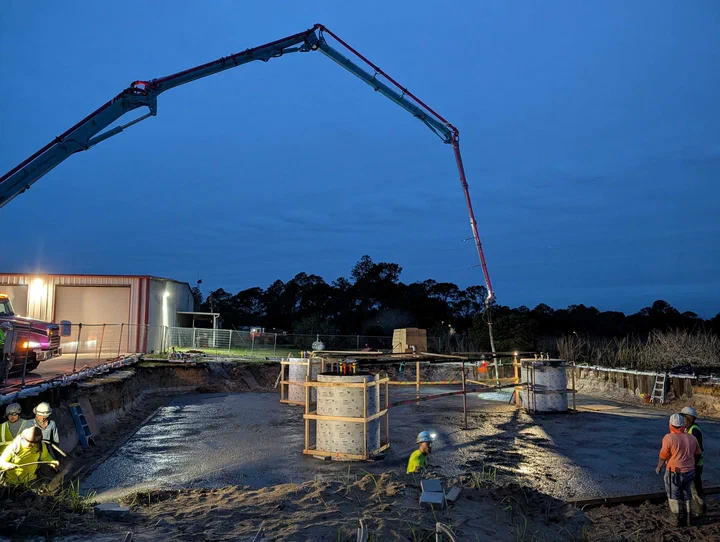
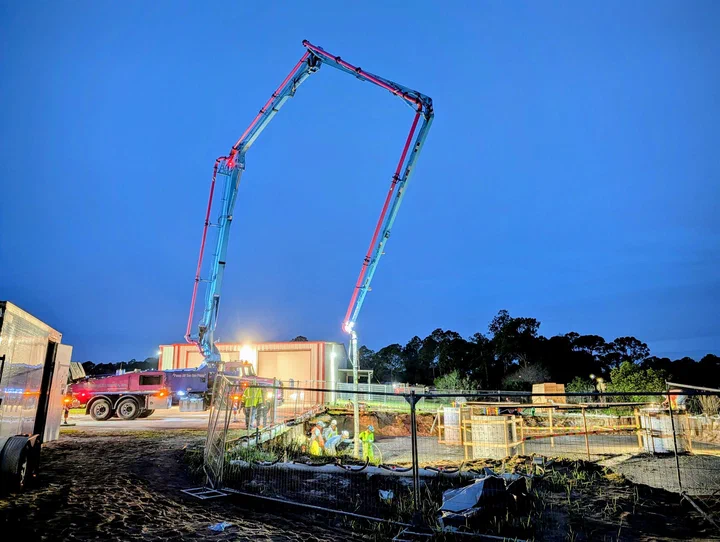
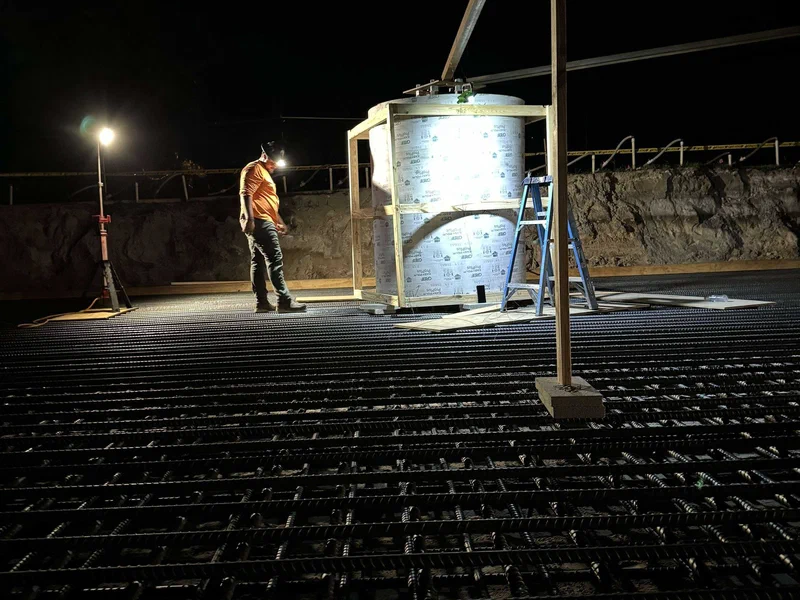
Tower foundations come in two families, and we handle both. Drilled piers are the most common on self-supporting and monopole sites, specified by your structural engineer from site-specific soils data. A typical self-supporting pier is 3 to 6 feet in diameter, 8 to 20 feet deep, with a rebar cage tied from #8 or #9 vertical bar and #4 hoops. Pier-mat and pad footings are what you’ll see on heavy self-supporting, guyed-anchor, and utility-grade sites where the engineer is spreading load across a wider footprint. Either way, the pour is run to the stamped drawing, not to crew preference. The 4-carrier mats on the Streamline Internet Hendry County buildout carried hundreds of cubic yards of concrete each, with active dewatering held through the dig on the high water table and night pours on the heaviest mats to keep cure temperatures in spec under Florida heat.
Before the concrete truck backs up, we’ve verified:
- Excavation depth and diameter match the stamped drawing to tolerance.
- Geotechnical engineer approvals on any soils deviation caught during excavation.
- The rebar cage is centered, plumb, has the correct cover on all sides, and has been inspected and signed off before we close it in.
- Anchor bolts are set in a template rig at the right elevation and bolt pattern.
- The ground ring is laid in and cadwelded to every structural leg.
- Slump and air-entrainment testing is arranged with the inspector.
On the pour, we vibrate every lift, check slump on arrival, and cast cylinders for break tests at 7, 14, and 28 days. Nothing about this is optional. Tower foundation design is governed by TIA-222-I and the structural concrete by ACI 318. We build to both, not to whichever one the crew feels like today.
The ground ring is the key to proper bonding.
A proper bonded ground ring is the single most common thing we see missing or done wrong on tower sites built by other crews. #2 bare copper laid around the foundation, cadwelded to every leg and every piece of equipment, sized and placed per engineer spec.
Installation order depends on site grade. Sometimes the ring goes in before backfill closes over it; on sites where the finish grade gets established first and the depth below frost line or engineer-required depth is dictated by that grade, the ring goes in after compaction to the correct trench depth. Either way, it gets inspected and cadwelded, not clamped.
We bond to Motorola R56 spec on every site. If your engineer of record has a different or stricter grounding spec (utility-grade substations sometimes do), we work from that. We never clamp where a cadweld is called for.
Access roads and compound finishing.
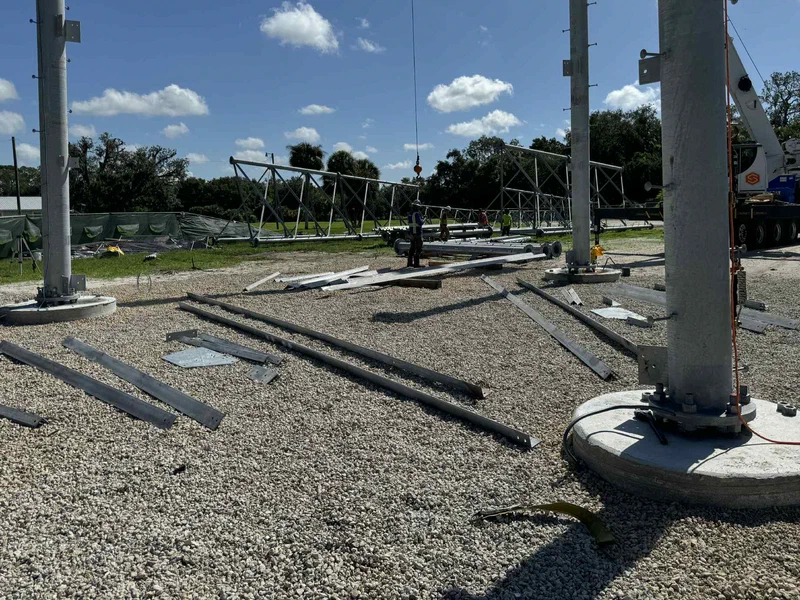
The crane that flies your steel is going to roll in on axles that demand a driveway spec’d to the actual ground bearing pressure, not a dirt two-track. Site access and driveways are part of scope on every new-build we run and squarely within our expertise. Typical approach: clear and grade the access route, lay geotextile fabric, compact a 6-12 inch base of crushed limestone or local aggregate, and crown the surface for drainage.
Compound finishing is the last piece. Weed-mat fabric under crushed stone, chain-link fence with top rail and barbed wire (or security-rated as specified), a swing gate sized for utility trucks, and any concrete cabinet pads the equipment layout calls for.
How it goes.
A foundation job runs 1 to 3 weeks of on-site work, gated mostly by concrete cure time. Here’s how a typical drilled-pier pour flows.
Site walk and access evaluation
Foreman on site with a soils-cone penetrometer, a laser rangefinder, and the stamped foundation drawing. We verify access, stake the tower center, flag utilities (One-Call performed before any dig), and pre-plan the pour route for the concrete truck.
Clear, grade, and access road
Trees down, stumps ground, site graded to drain. Access road cut, geotextile laid, crushed limestone placed and compacted. Silt fence goes up at the downslope edge of disturbance before any dirt moves.
Excavation and anchor template
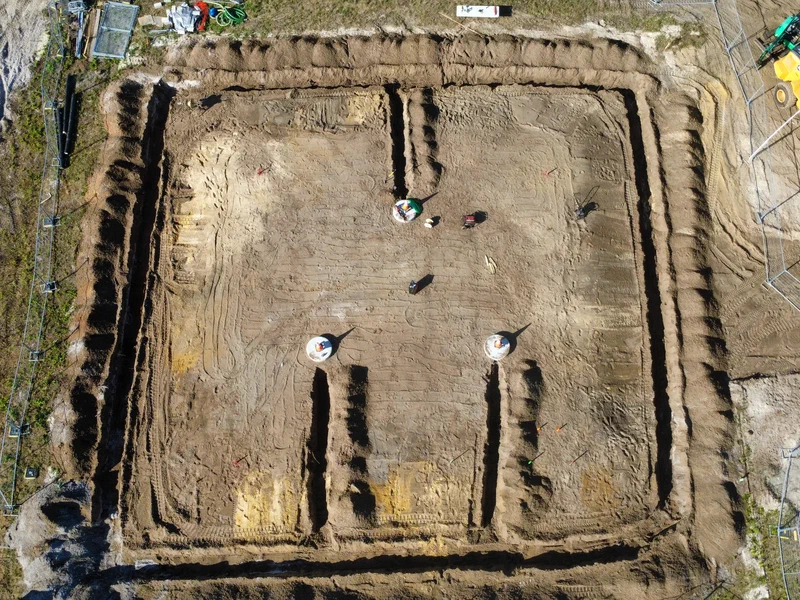
Drilled pier or spread footing excavated per spec. Sides checked for square and plumb. Anchor bolt template set at exact elevation and bolt-pattern, cross-braced so it doesn’t move during the pour.
Rebar cage and ground ring
Cage tied per drawing, with the correct vertical count, hoop spacing, and splice laps. Cage set in the hole, cover verified on all sides. Ground ring laid around the pier perimeter and cadwelded to every structural anchor bolt or leg connection before any backfill or concrete.
Concrete pour and finish
4,000–5,000 PSI mix per spec. Slump and air checked on arrival. Cylinders cast for inspector break tests. Each lift vibrated to consolidate. Anchor bolts checked for plumb and elevation during set. Top finished to drawing detail, whether that’s a smooth pedestal, a stem wall, or a mat footing.
Cure, backfill, compound
Foundation cures to 70% strength in about 7 days and to 100% at 28. Crew moves onto backfill and site finishing while the pour cures: weed-mat, compound stone, fence, gate, cable-tray trenching, and any equipment cabinet pads. Steel erection gets scheduled off the 7-day mark at minimum, 28 for heavy loading.
Handover
As-built grade survey, ground-ring inspection report, concrete break-test results, and photo documentation delivered to your engineer of record. Nothing closes out without the paperwork.
Built to standard. Inspected to code.
The regulatory and engineering frameworks we work to on every foundation pour, whether the site is a 150-foot WISP monopole or a 300-foot self-supporting for a utility SCADA network.
TIA-222-I
Current ANSI structural standard for antenna-supporting structures. Governs tower foundation design, anchor-bolt pull-out values, plumb tolerance, and the geotechnical inputs that drive pier sizing.
ACI 318
American Concrete Institute structural-concrete code. Governs mix design, rebar lap-splice lengths, cover requirements, vibration, and strength testing on every pour we place.
ACI 301 / 305 / 306
ACI specifications for structural concrete, hot-weather concreting, and cold-weather concreting. We follow them when the job-site temperature pushes standard pour conditions out of spec.
Motorola R56
The industry-standard grounding and bonding spec for communication sites. Every ground ring, cadweld, and bond on our sites is R56-compliant unless your engineer calls for something stricter.
NEC Article 810
National Electrical Code provisions for antenna installations and grounding. Governs bonding of masts, feedlines, lightning suppressors, and lead-in conductors.
OSHA 1926 Subparts P and Q
Federal standards for excavations (Subpart P) and concrete construction (Subpart Q). Shoring, sloping, rebar impalement protection, formwork reshoring, and all the safety work the client doesn’t see but we can’t skip.
Local stormwater and zoning
Silt-fence, erosion-control, and stormwater permits handled per local jurisdiction. Tree-clearing and grading coordinated with your land-use team or permit agent so nothing stops mid-job.
FAA 7460-1 / FCC ASR
When the overall structure triggers FAA notification (200 ft AGL or near-airport), we coordinate the 7460-1 filing and FCC Antenna Structure Registration as part of the turnkey scope on new builds.
Gear & certifications.
Equipment
- Excavators: Volvo EC series, Sany SY series, 8 to 50+ ton depending on pier depth
- Drilled-shaft auger rigs for pier foundations (sub-contracted spec rigs for deep piers)
- Wheel loaders and skid steers for site prep, grading, stone placement
- Compactors, plate tampers, and vibratory rollers for base and backfill
- Rebar bending, cutting, and tying tools; on-site cage-build capability
- Anchor-bolt template rigs, laser levels, and total stations for elevation control
- Concrete vibrators, screeds, and finishing tools; cylinder molds for break tests
- Cadweld tooling and bare-copper inventory for ground-ring installs
- One-ton dump trucks and tandem-axle trailers for aggregate and spoils hauling
Certifications & insurance
- OSHA 10 / 30 compliant crews
- Competent-person certified for excavation and shoring per 1926 Subpart P
- ACI Field Technician certifications on lead concrete hands (where required)
- Ground-ring and cadweld training per Motorola R56
- Fully insured: general liability and workers’ compensation
Questions we get a lot.
How deep does a tower foundation go?
It depends entirely on the engineered design, which is driven by soils, tower type, height, and loading. Rough ranges we see regularly:
- Drilled-pier foundations (monopole or self-supporting): 8 to 20 ft deep, 3 to 6 ft diameter.
- Spread footings / mats (heavy self-supporting and high-wind or poor-soil sites): 3 to 6 ft thick mat, 10 to 20 ft square or octagonal on typical builds, up to roughly 60 to 65 ft on heavy-loaded sites in poor soil types or high wind zones.
- Guy anchors: concrete blocks typically 4 to 8 ft on a side, with significant rock or soil cover.
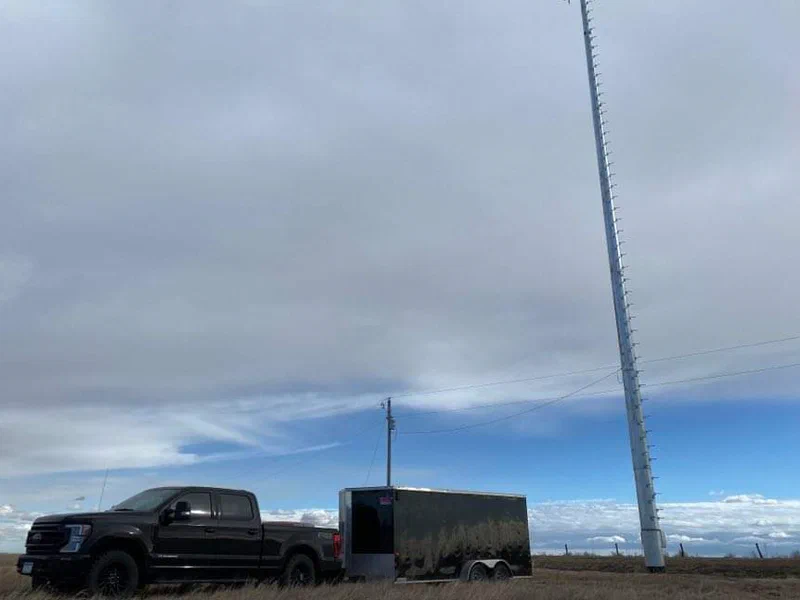
- Direct-embedment monopoles: pole set 10 to 15 percent of total height into an augered hole, backfilled with flowable fill or concrete. See our direct embedment service.
We work from your engineer of record’s stamped design. No foundation gets poured without one. If you don’t have an engineer yet, we can bring one in.
How long does a foundation pour take, and when can you erect steel?
Physical on-site work depends on foundation type:
- Drilled-pier foundations: typically 3 to 5 working days from mobilization to a cured pad.
- Pier mat and pad footings: typically about 2 weeks from mobilization through finish, driven by excavation volume, rebar tonnage, and form-and-pour sequencing.
Steel erection schedules to 28-day cure for full-strength loading, or to whatever the engineer of record allows based on the break-test results. The longest single variable is concrete cure, which isn’t something you accelerate in the field. We schedule steel crews off the engineer’s break-test approval, not off a round number, so nobody is stacking on under-strength concrete.
What concrete strength do you pour?
Standard tower foundations spec 4,000 PSI concrete, commonly bumped to 4,500 or 5,000 PSI for heavier-loading and coastal sites. Mix design is driven by the stamped foundation drawing. We order from local batch plants, verify slump and air entrainment on arrival, cast cylinders for break tests at 7, 14, and 28 days, and vibrate every lift.
Cold-weather pours follow ACI 306 (temperature monitoring, insulated blankets, heated enclosures as needed). Hot-weather pours follow ACI 305 (early-morning starts, evaporation retardants, extra curing water). We don’t pour in conditions your engineer or the ACI codes don’t allow.
How do you handle the geotechnical survey?
The answer is thoroughness up front. We push for a geotechnical survey that reflects the actual pier, mat, and anchor footprint, which usually means more than a single bore on site. Multiple bores across the tower center and anchor locations catch the kind of variance (rock pockets, saturated sand lenses, uniform-refusal clay) that a single-bore report can miss.
That attention to detail is what separates a clean pour from a site where the foreman is calling an emergency re-design with concrete trucks staged on the driveway. We’d rather invest in the geotech work up front than pause the pour and eat the day.
Do you handle the ground ring, or is that a separate crew?
Do you build access roads and compound finishing too?
Can you work on utility-grade sites with stricter engineering?
What tower types do you foundation for?
- Self-supporting lattice (3-leg): drilled pier per leg or single mat foundation, 100 to 300 ft height class.
- Guyed towers: central pier foundation plus typically three guy-anchor blocks set to engineered pre-load spec.
- Monopoles: drilled pier with anchor-bolt pattern, or a spread footing.
- Direct-embedment monopoles: augered hole, backfilled with flowable fill or concrete. No spread footing. See our direct embedment service.
- Equipment and cabinet pads: slab-on-grade pours for generators, cabinets, BBUs, and ice bridges.
How much does a foundation cost?
Fixed fee on defined scope, with unit rates and change orders for field conditions. Quoted off your stamped drawings. For usable order-of-magnitude:
- Small monopole pier (WISP-scale, 60–120 ft tower): typically lower five figures for a straightforward drilled pier on an accessible site.
- Self-supporting or guyed pier complex (180–300 ft tower): usually mid five to low six figures, with rebar tonnage and concrete volume driving most of the spread.
Site access, soils, haul distance, and permit requirements are the variables. Send us the drawings and you’ll have a line-itemed quote inside a week.
What's your service area?
Do you pull permits?
How do I get started?
Send us the site (address or coordinates), the stamped foundation design if you have it, intended tower type and height, and your target schedule. If you don’t have an engineer yet, we can bring one in.
Request a quote here or call us at (763) 280-6050. Most customers have a line-itemed quote within a week.
Don’t see your question? Ask us directly. We answer every scoping call.
Related services.
New Site Builds
Empty dirt to operational tower, one crew, one point of contact.
Tower Erection
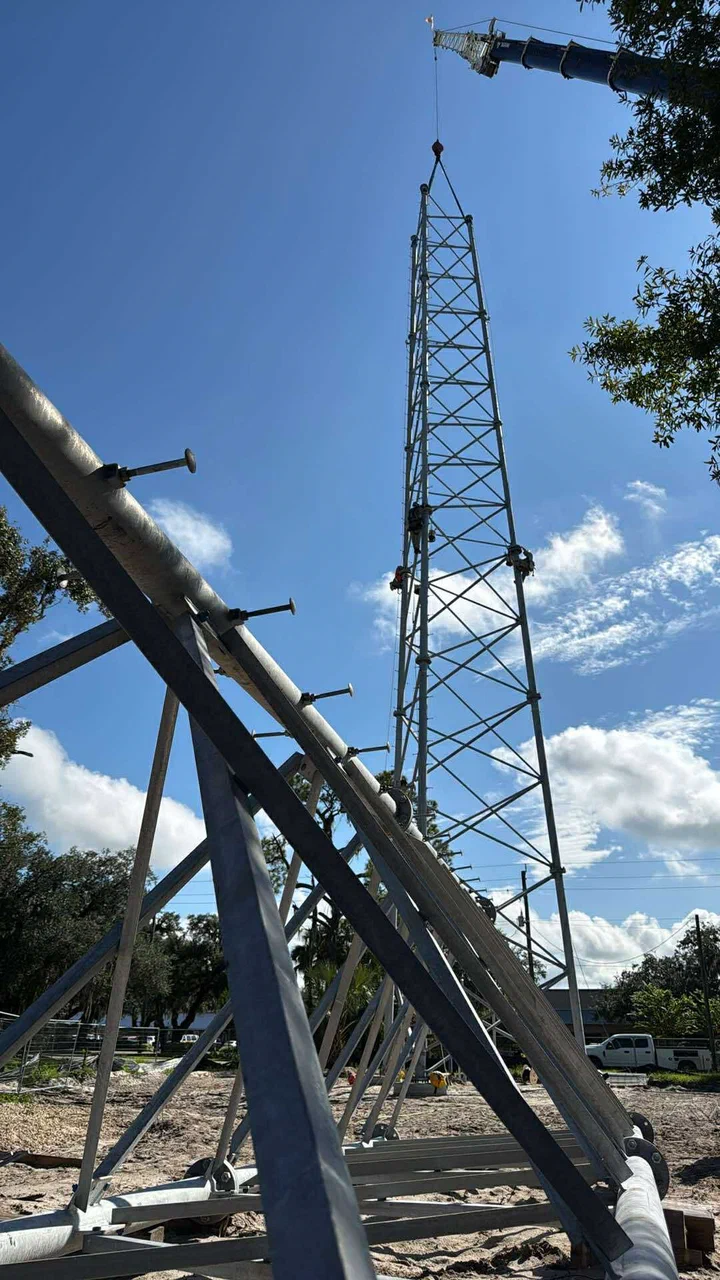
Guyed, self-supporting, and monopole structures up to 300ft.
Direct Embedment Monopoles
Foundation-free monopoles set into augered holes. Fast to deploy.
Grounding & Cadwelding
Ground rings, exothermic welds, bonding to NEC and manufacturer spec.
Page last updated July 30, 2026.
Tell us the site.
We'll bring the steel.
Send the location, tower type, scope, and timeline. We come back with a quote, a crew, and a schedule you can build a business around.