
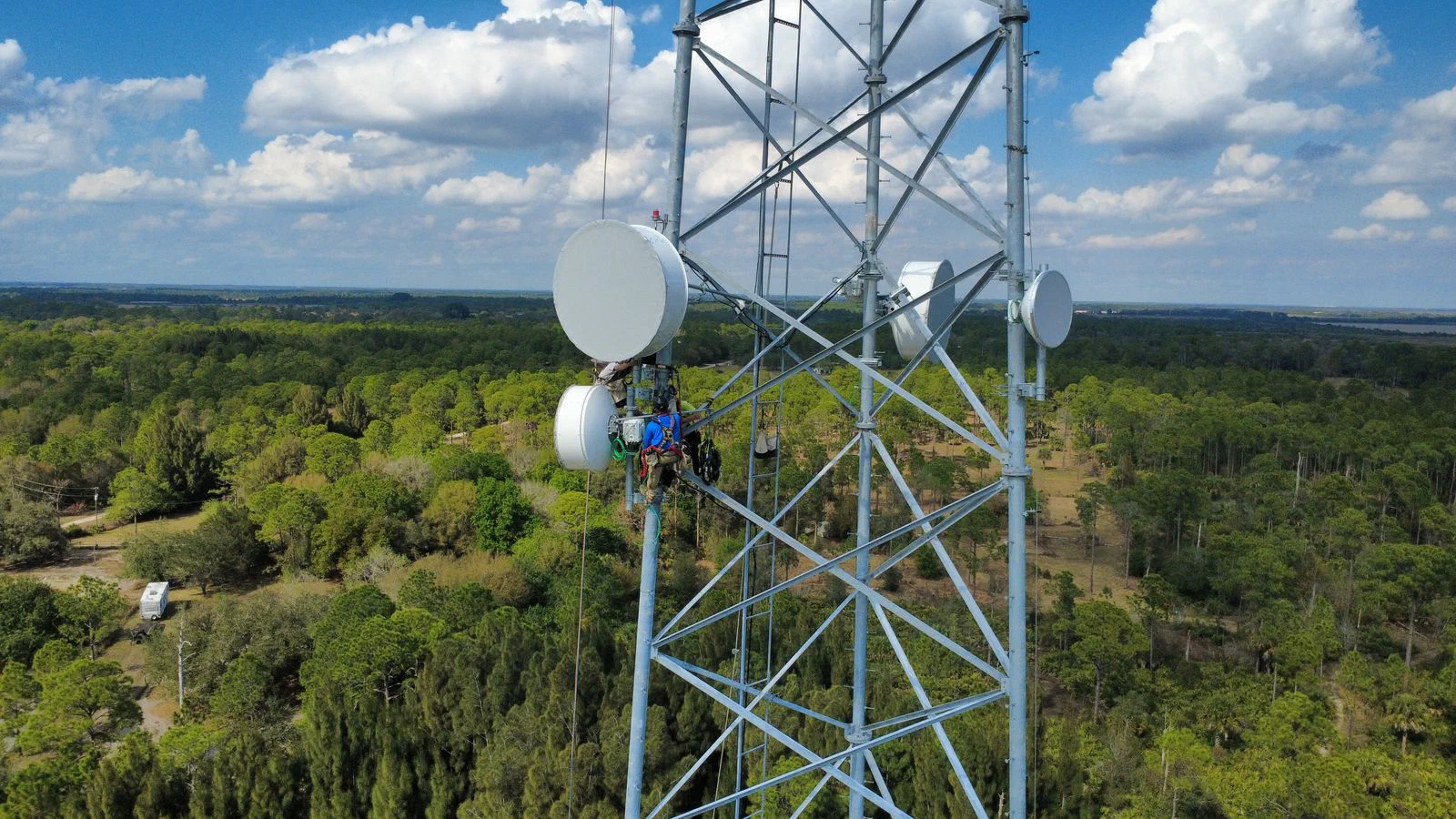
Microwave Alignment: Dish, Path, and PTP Link Alignment
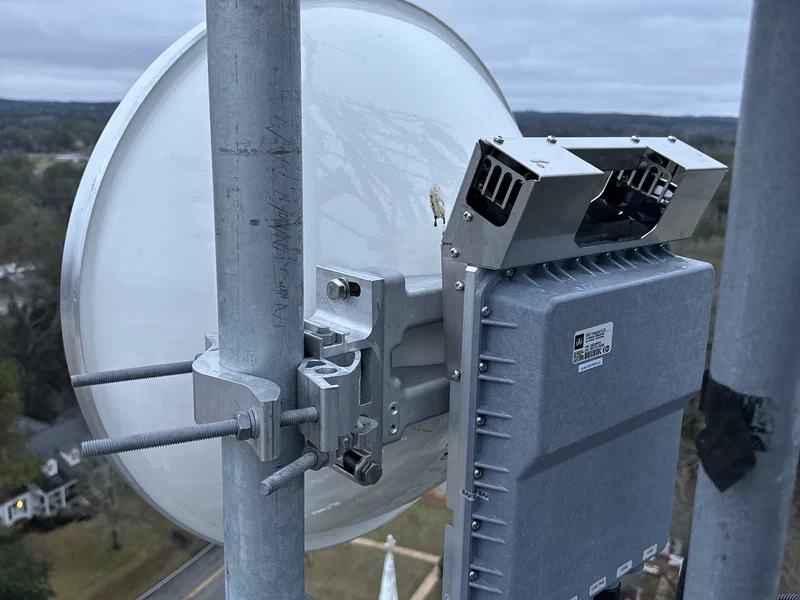
A microwave link is only as good as its aim. Vertical Axis crews align licensed and unlicensed microwave dishes and point-to-point links: new installs, re-aligns after storms or tower work, and low-RSL links that never hit their numbers. Both ends live, peaked on RSL against the link budget with the radio’s native diagnostics, brackets torqued, weatherproofed last. On Streamline Internet’s Hendry County buildout, 20+ alignments came in at spec on the first sweep.
What's included.
New links, re-aligns, and troubleshooting on point-to-point microwave, carrier-grade or WISP-class. One end or both, one link or a program.
- New-link alignment on licensed Part 101, unlicensed Part 15, and E-band / V-band millimeter-wave paths
- Re-alignment after storms, high wind, ice, or tower work that moved a dish
- Low-RSL and fade troubleshooting: aim, mount, bracket torque, and polarization checked before anyone blames the radio
- Coordinated two-end alignment: our crews on both ends, or ours on one end and yours on the other
- Rough aim set from the path drawing’s azimuth and elevation before fine alignment starts
- Fine alignment peaked on RSL using the radio’s native diagnostics: RSL telemetry, SNR, packet error rate, and modulation lock state
- Measured RSL checked against the predicted RSL in the link budget, so a side-lobe peak never gets signed off as aligned
- Precision antenna alignment on tight-tolerance licensed paths where the design calls for it
- Mount and bracket torque locked per manufacturer spec
- Weatherproofing, drip loops, and grounding kits done last, after both ends confirm in spec
- Surge suppression and bonding to Motorola R56, or IEEE 80 on utility sites
- 72-hour soak test on newly commissioned links
- Alignment log delivered: RSL at both ends, azimuth, elevation, and photos
They've also handled over 20 microwave alignments for us, all hitting spec from our coordinators without issues. That level of consistency is hard to find.
Need a microwave link aligned on a real deadline?
Send your site details. We come back with a quote, a crew, and a schedule.
Why links drift, and why the second climb costs more than the first.
Microwave beams are narrow, and they get narrower as dishes get bigger and frequencies get higher. Very little movement at the dish separates a link running at full modulation from one that drops capacity every time the weather turns.
Links lose aim for ordinary reasons: wind and ice loading on the dish, a bracket that was never torqued to spec, a pipe mount that flexes, or work elsewhere on the tower that bumped it. Some were never aimed right in the first place and have been running a few dB short since commissioning.
Every misaligned link costs a second climb, and on a multi-link program the re-climbs stack up fast: crew time, crane time on the heavier dishes, and a commissioning schedule that slips link by link. The fix is to get the aim right the first time and lock it so it stays there.
How we align a link.
- Path data first. Endpoint coordinates, antenna heights, dish sizes, frequency, polarization, and the predicted RSL for each end, from your path design or link budget.
- Rough aim. Dish set to the path azimuth and elevation off the path drawing, mount snugged so it can still be fine-tuned.
- Fine alignment, both ends live. Each end peaked on RSL in turn, using the radio’s native diagnostics (RSL telemetry, SNR, packet error rate, modulation lock).
- Check against the link budget. Measured RSL compared with the predicted RSL. A link that peaks well short of prediction is usually on a side lobe or fighting a mount problem, and gets re-swept, not signed off.
- Lock it down. Bracket torque per manufacturer spec, then weatherproofing, drip loops, and grounding kits, once both ends are confirmed in spec.
- Log it. RSL at both ends, azimuth, elevation, and photos in the alignment log your NOC or path coordinator gets at closeout.
What first-sweep spec looks like.
Across Streamline Internet’s Hendry County, Florida buildout, Vertical Axis crews executed more than 20 microwave alignments. Per Streamline CEO Lou Elliott, every one hit spec from the path coordinators on the first sweep: RSL matching the link budget, no coordinator pushback, no re-climbs. Three habits did it:
- Rope-rigging discipline. Dishes hauled up clean and set on the steel within fabrication tolerance before the first RSL reading. A big dish flexed or torqued on the way up will never align cleanly.
- The radio’s own diagnostics, read by an experienced lead hand who knows when to keep tightening and when to back off and recheck the steel.
- Weatherproofing last. No tape goes on until both ends are confirmed in spec.
Re-aligns, storm work, and links someone else installed.
Not every alignment job is a new link. We also climb for:
- Post-storm re-aligns. Wind and ice knock dishes off aim. If a revenue link is down, call the emergency line: we triage, re-align to the RF design, and swap to staged spares where needed.
- Links installed by someone else. We verify aim, mount, torque, and polarization against your path design, re-align, and log before-and-after RSL so you know whether the problem was the dish, the mount, or the path.
- Tower work near live links. When modifications or other contractors’ work put dishes at risk, we can record RSL before the work and re-align anything that moved after.
- Program rotations. Backhaul rings and multi-site WISP networks re-aligned site by site on one schedule.
The same crews run the full microwave backhaul installation scope, from path survey and FCC Part 101 licensing to the 72-hour soak test.
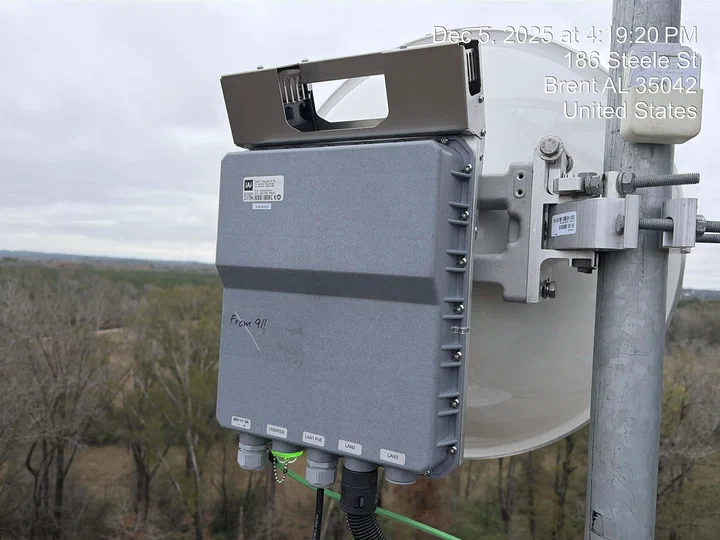
Microwave link symptoms we get called for
| Symptom | Common causes | What we check first |
|---|---|---|
| RSL below prediction since commissioning | Side-lobe alignment, polarization mismatch, path obstruction | Re-sweep both ends against the link budget |
| RSL dropped after a storm | Dish walked off aim, loose bracket, flexing mount | Mount and torque, then re-align both ends |
| Modulation drops in rain the link used to ride through | Fade margin lost to aim drift | RSL against prediction, then re-peak |
| Errors or flapping in clear weather | Water in connectors, hardware fault, interference | Radio diagnostics, connectors, on-radio spectrum scan |
| Link down | Radio, power, surge damage, or a dish knocked off aim | Emergency triage, staged spares, re-align |
Alignment is usually the cheapest fix on that list, which is why it gets checked first. When it isn’t the problem, the alignment log still tells you what is.
Send us the link details, or for a link that’s down right now, call (763) 280-6050.
How an alignment runs.
Most re-aligns come down to one climb per end when the mount is sound and the far end is reachable the same day. New links add commissioning and a 72-hour soak test.
Path data and access
Both endpoint coordinates, antenna heights, dish sizes, frequency and polarization, predicted RSL, and radio make and model. Tower access, climb plan, and who’s on the far end confirmed before mobilization.
Pre-climb check
Radio status and current RSL pulled from the ground first, so we know whether we’re chasing aim, a mount problem, or a hardware fault before anyone climbs.
Rough aim and mount
Dish set to path azimuth and elevation off the drawing. Pipe, mount, and bracket checked for slip and flex before fine work starts.
Fine alignment, both ends
Each end peaked on RSL with the radio’s native diagnostics, iterating until both ends sit at the link-budget prediction. Precision antenna alignment on tight-tolerance licensed paths where the design calls for it.
Lock, weatherproof, ground
Bracket torque per manufacturer spec. Weatherproofing, drip loops, grounding kits, and surge protection after both ends confirm in spec.
Verify and hand over
RSL, modulation, and error counts confirmed with your NOC; 72-hour soak test on newly commissioned links. Alignment log and photos delivered at closeout.
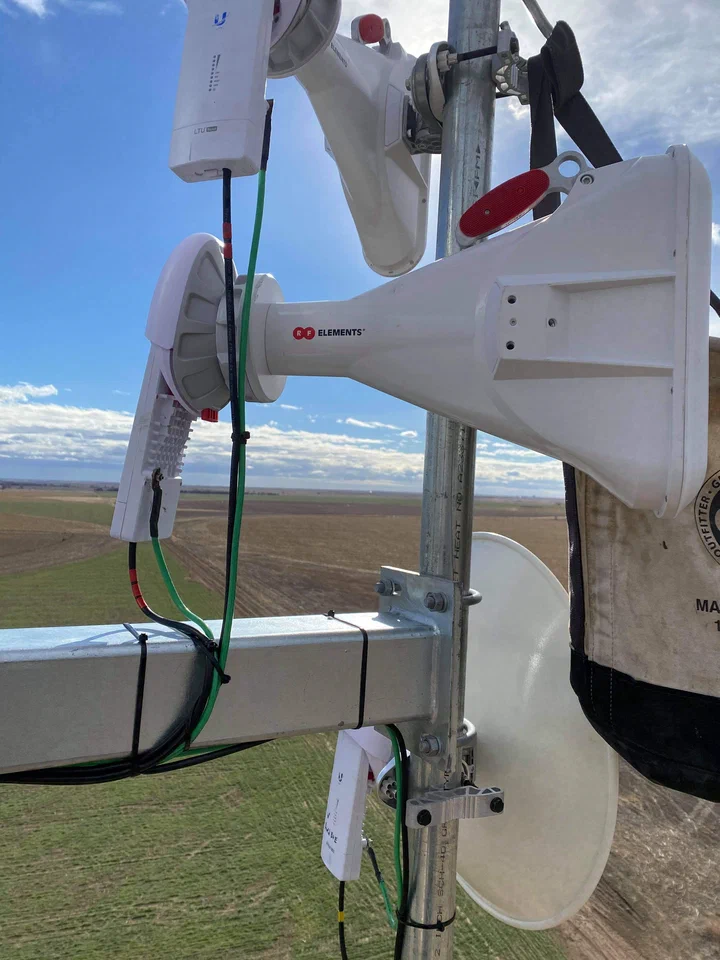
Aligned to the path. Built to the code.
Alignment is judged against the link budget, but the mount, the grounding, and the climb are held to the same standards as every other tower job.
FCC Part 101
Licensed fixed microwave in the 6 to 42 GHz bands and light-licensed E-band. Links aligned to the coordinated, licensed path, not to whatever peaks.
FCC Part 15
Unlicensed 5, 24, and 60 GHz links. EIRP limits and interference behavior respected at alignment, with on-radio spectrum scan where the noise floor is suspect.
Manufacturer procedures
Mount, bracket torque, weatherproofing, and grounding-kit procedures per Aviat, SAF Tehnika, Siklu, Nokia, Ubiquiti, Cambium, and Mimosa documentation.
TIA-222-I
ANSI structural standard for antenna-supporting structures. Drives dish loading, ice loading, and mount design on every tower-mounted dish.
Motorola R56 / IEEE 80
Grounding and bonding for communication sites. R56 by default; stricter IEEE 80 practice on utility microwave sites.
OSHA 1926 / ANSI A10.48
Safety at height. 100% tie-off, authorized rescue, and a site-specific safety plan on every climb.
Gear & certifications.
Equipment
- Platform-native alignment tooling for Aviat, SAF Tehnika, Siklu, Ubiquiti, Cambium, and Mimosa platforms
- Precision antenna alignment for tight-tolerance licensed microwave paths
- Power meters and variable attenuators for RSL verification
- On-radio spectrum scan for interference checks (native tooling on Aviat, SAF, Siklu, Ubiquiti, Cambium, Mimosa)
- Rope rigging for clean dish hauls
- Alignment tools and common spares for Aviat, SAF Tehnika, and Siklu on emergency response
- Self-contained crew trailers: RF tooling, rigging, and spares
Certifications & insurance
- NATE ClimberSafe / SafetyLMS climbers on every install
- Platform-fluent installers on Aviat, SAF Tehnika, Siklu, Ubiquiti, Cambium, Mimosa
- FCC General Radiotelephone Operator License (GROL) on lead RF hands
- OSHA 10 / 30 compliant crews
- Fully insured: general liability and workers’ compensation
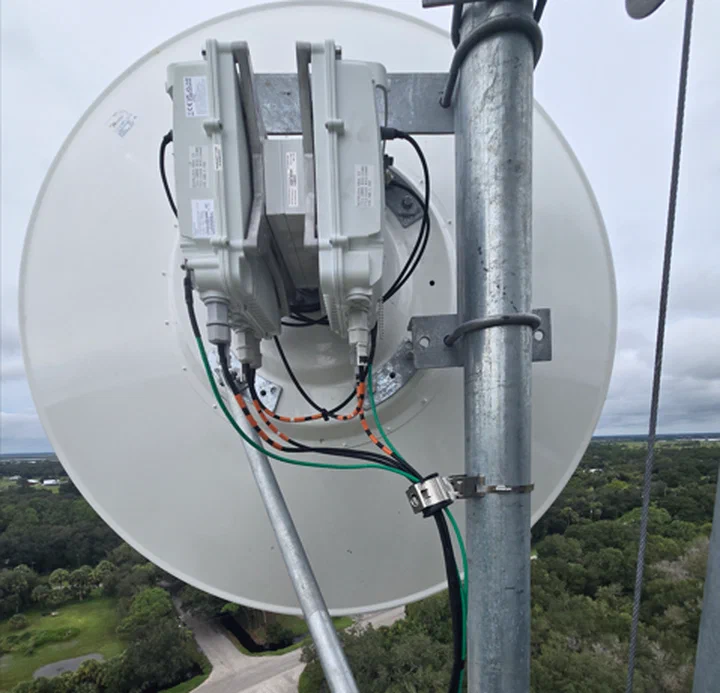
Microwave alignment questions.
What is microwave alignment?
Microwave alignment is aiming the two antennas of a point-to-point microwave link at each other precisely enough that the received signal level (RSL) at each end matches what the path calculation predicts.
Microwave beams are narrow, so small aiming errors cost real signal: lower RSL, less fade margin, lower modulation, and less capacity, especially in rain. Alignment is done with both radios live, peaking each end in turn, then locking the mounts so the link stays aimed.
How do you align a microwave dish?
- Collect the path data: coordinates, antenna heights, frequency, polarization, and predicted RSL.
- Rough-aim the dish to the path azimuth and elevation.
- Fine-align each end in turn with both radios live, peaking on RSL using the radio’s native diagnostics.
- Compare measured RSL with the link budget to confirm the main lobe, not a side lobe.
- Torque the bracket to manufacturer spec, then weatherproof and ground.
- Log RSL, azimuth, elevation, and photos for your NOC or path coordinator.
What RSL should a properly aligned link hit?
Why did my microwave link degrade or drop after a storm?
Wind and ice load the dish and mount. A bracket that wasn’t torqued to spec, or a pipe mount that flexes, lets the dish walk off aim. Lightning can take out radios and surge protection.
Rain itself attenuates higher-frequency links, but a well-designed link rides through rain with adaptive modulation. If the link stays degraded after the weather clears, the aim or the hardware usually moved. We check RSL against the link budget, inspect the mount, and re-align. For a down revenue link, call the emergency line.
Can you re-align a link another contractor installed?
How long does a microwave alignment take?
Which radios and bands do you align?
- Licensed Part 101: 6, 11, 18, 23, 32, 38, and 42 GHz.
- Lightly licensed E-band: 70 and 80 GHz.
- Unlicensed: 5, 24, and 60 GHz.
Carrier-grade platforms include Aviat (WTM, CTR, Eclipse), SAF Tehnika (Integra, CFIP), Siklu EtherHaul, and Nokia licensed microwave. WISP-class PTP includes Ubiquiti airFiber, Cambium PTP, and Mimosa B-series.
Do you align sector antennas and CBRS too?
What do you need from us?
How much does microwave alignment cost?
Where do you work?
How do I get started?
Send the path: both endpoints, the radios, the predicted RSL, and what the link is doing today.
Request an alignment quote or call (763) 280-6050. For a down revenue link, call now.
Don’t see your question? Ask us directly. We answer every scoping call.
Related services.
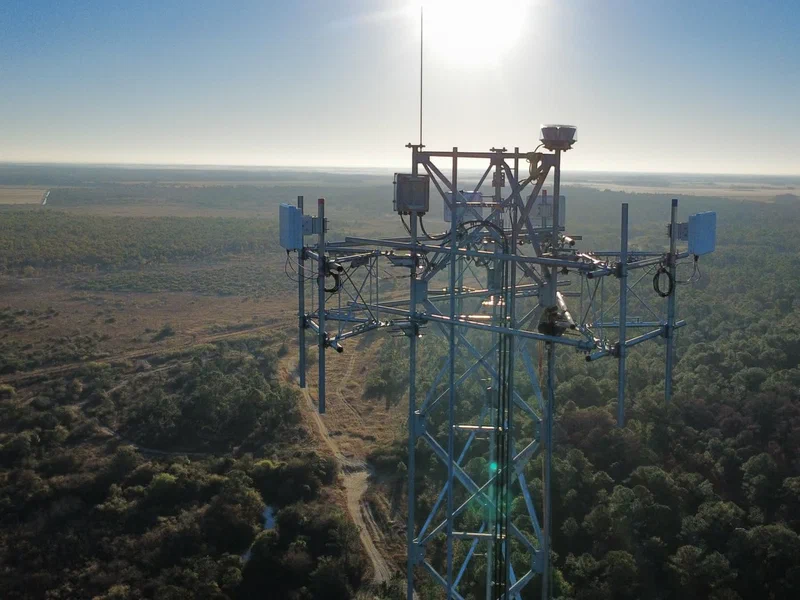
Microwave Backhaul
Point-to-point links, redundant rings, licensed and unlicensed.
Sector & Backhaul
Sector antennas, backhaul dishes, horn arrays, aligned and sealed.
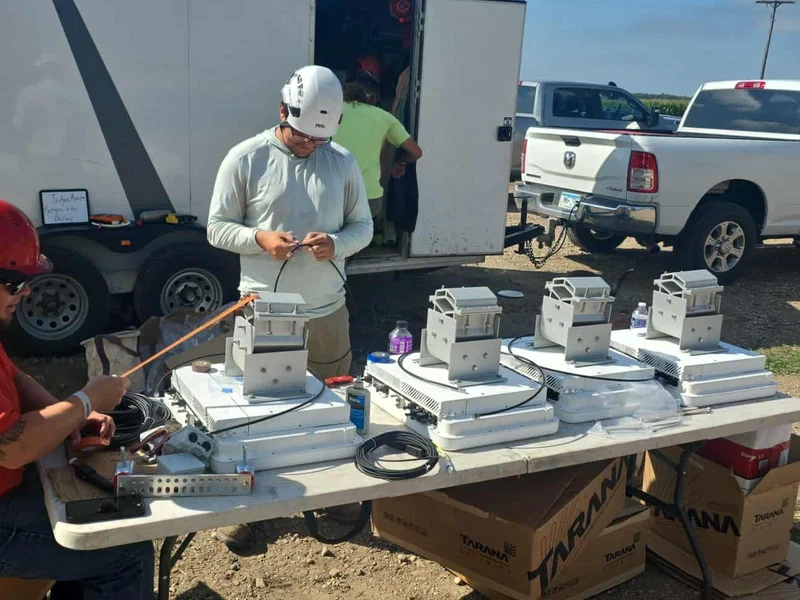
Antenna & Radio Install
Antennas, radios, fiber, DC, and Cat6. Ubiquiti, Cambium, Mimosa, Tarana, Nokia, and more.
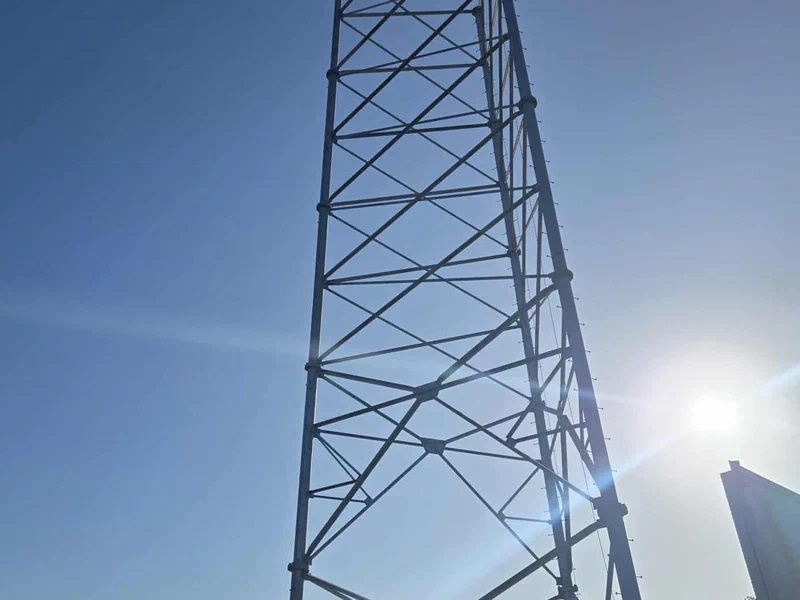
Self-Supporting Towers
Three-leg lattice towers to 300 ft. Pier or mat foundations, crane-set steel, plumbed to L/1500.
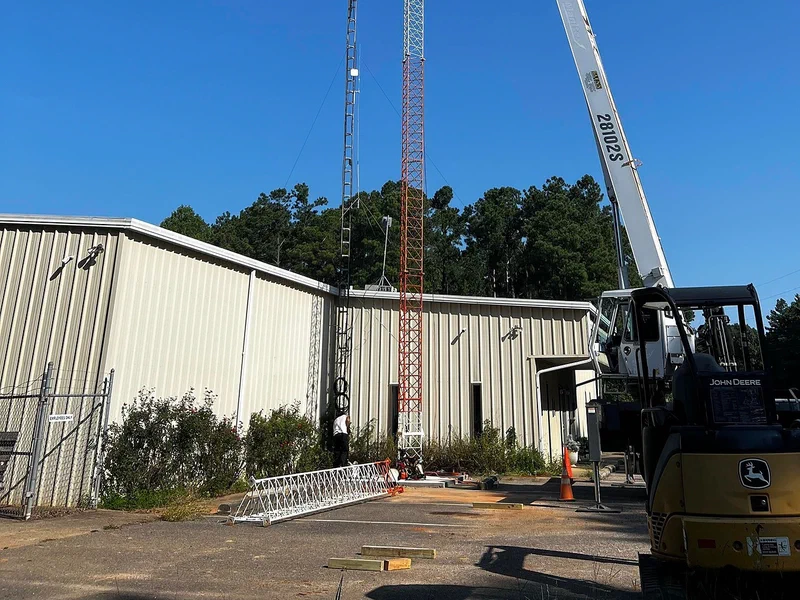
Tower Modifications
Antenna swaps, feed-line replacement, load-bearing upgrades.
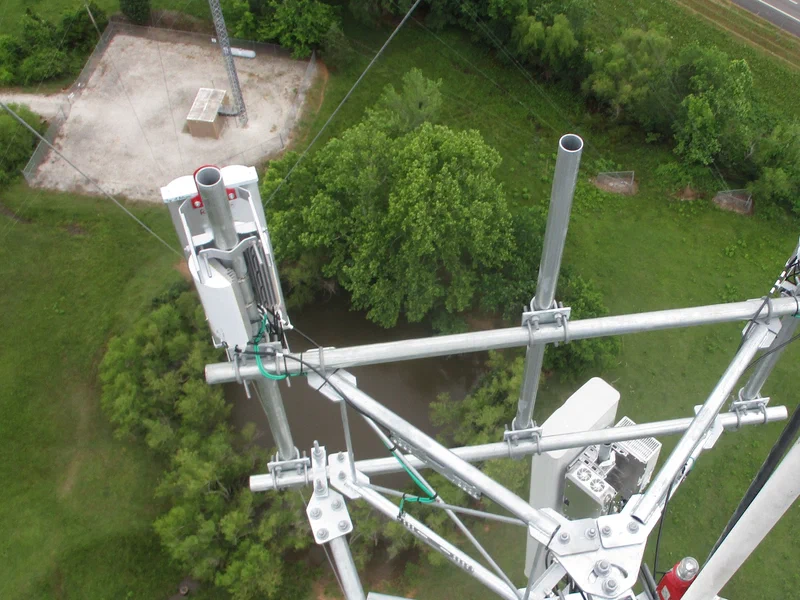
Maintenance & Inspection
Inspections, repairs, and post-storm response for a 20-year asset.
Page last updated October 28, 2026.
Tell us the site.
We'll bring the steel.
Send the location, tower type, scope, and timeline. We come back with a quote, a crew, and a schedule you can build a business around.