
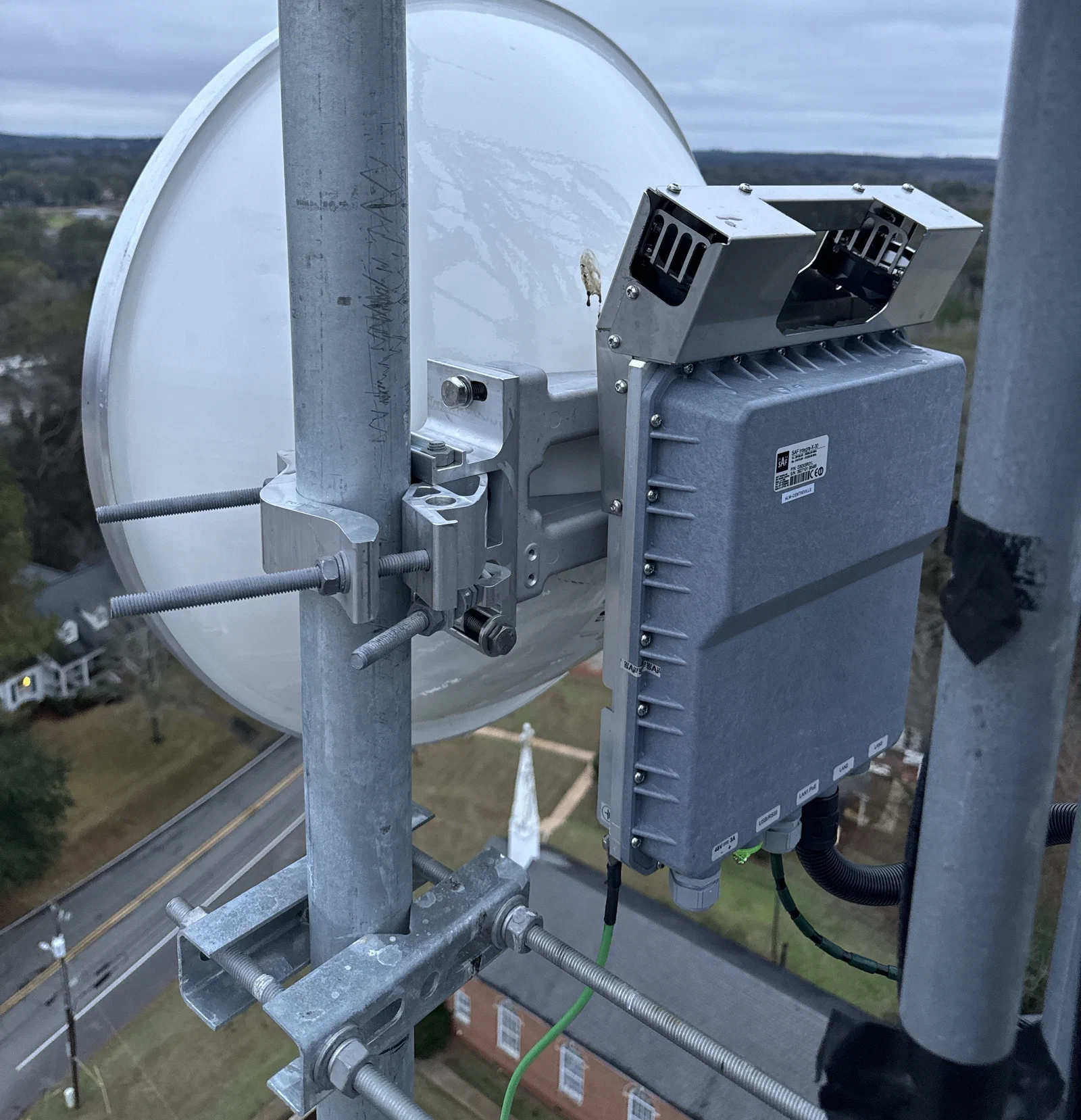
Microwave Backhaul Installation
Point-to-point microwave done right, on the right gear. Licensed carrier-grade Part 101 links, unlicensed 5 and 24 GHz prosumer PTP, 60 and 80 GHz millimeter-wave short hops, and redundant-ring topologies. Vendor-neutral advisory backed by long-term relationships with Aviat, SAF Tehnika, and Siklu.
What's included.
Full microwave backhaul scope from path study to SLA-grade commissioned link. Licensed Part 101, unlicensed Part 15, and mmWave E-band under one scope of work.
- Path survey and line-of-sight study (desktop + field verification where needed)
- Path loss, fade-margin, and rain-fade modeling per ITU-R P.530
- FCC Part 101 license filing, coordination, and frequency assignment
- Unlicensed 5 GHz, 24 GHz, 60 GHz (V-band), and 80 GHz (E-band) link install
- Licensed 6, 11, 18, 23, 32, 38, and 42 GHz carrier-grade link install
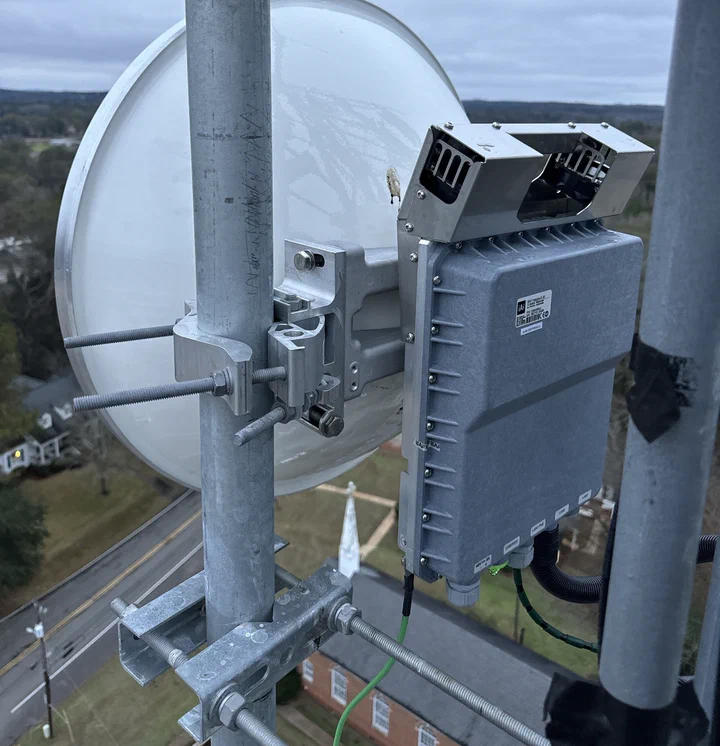
- Carrier-grade radio install: Aviat WTM / CTR / Eclipse, SAF Integra / CFIP, Siklu EtherHaul, Nokia licensed microwave
- Prosumer PTP install: Ubiquiti airFiber 5XHD / 4X / 11 / 60, Cambium PTP 550 / 670, Mimosa B5 / B11
- Ring topology and 1+1 hot-standby protection deployments
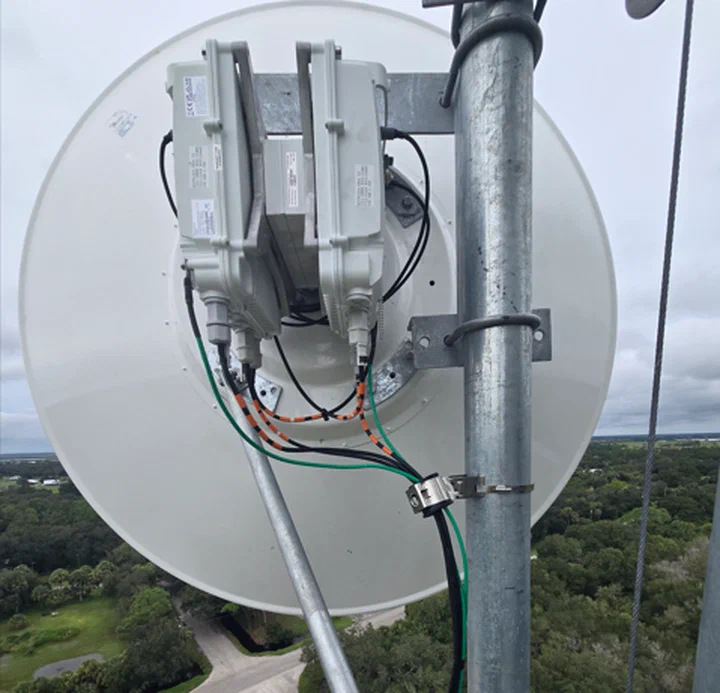
- IDU (indoor unit) to ODU (outdoor unit) waveguide or Ethernet runs
- Adaptive modulation tuning and link-budget verification
- Antenna alignment (RSSI / SNR peaking and precision-aligned where the design calls for it)
- Grounding and surge suppression to Motorola R56 or IEEE 80 (utility sites)
- LTE/5G S1 backhaul install, tested against operator SLA targets
- TDM / E1 / TDM-over-Ethernet emulation for legacy utility and public-safety circuits
- Commissioning: RSL measurements, fade-margin verification, 72-hour soak test
- Documentation: path drawings, license records, alignment logs, as-built package
Need microwave backhaul installation on a real deadline?
Send your site details. We come back with a quote, a crew, and a schedule.
Microwave done right means picking the right gear, not the gear the rep pushed.
The microwave backhaul market has real products at 1,000 dollars a link and real products at 60,000 dollars a link, sold by reps who are all convinced their gear is the right answer. It isn’t. The right product depends on what the link is carrying, the distance, the local climate, and whether the traffic can tolerate a rain event without taking the site down.
Vertical Axis runs microwave installs across the full span. Prosumer PTP at one end, carrier-grade licensed Part 101 at the other, E-band and V-band mmWave for short high-capacity hops in the middle. Long-term installer relationships with Aviat, SAF Tehnika, and Siklu mean we can have an honest vendor-neutral conversation with you about what fits, not a sales pitch.
Prosumer vs carrier-grade. When to use what.
Two different classes of gear, two different jobs.
Prosumer / WISP-class PTP. Ubiquiti airFiber (5XHD, 4X, 11, 60), Cambium PTP 550 / 670, Mimosa B5 / B11. Budget roughly 1,000 to 5,000 dollars per link. Mostly unlicensed (5, 24, 60 GHz). Works well for:
- WISP distribution backhaul
- Short-range business-to-business links
- Temporary or event-based connectivity
- Aggregate capacity up to the gigabit class on a good day
Carrier-grade microwave. Aviat WTM / CTR / Eclipse, SAF Integra / CFIP, Siklu EtherHaul, Nokia licensed microwave. Budget 10,000 to 60,000+ dollars per link. Mostly licensed Part 101 (6, 11, 18, 23, 38, 42 GHz) or licensed E-band (70 / 80 GHz). Required for:
- LTE and 5G S1 backhaul
- Cellular RAN aggregation and transport
- Utility SCADA teleprotection with sub-10 ms latency and jitter tolerances
- Public-safety radio networks under statutory uptime requirements
- Anything with an SLA behind it
The S1 question. LTE and 5G cells hang off their EPC or 5GC via S1 and N2 signaling traffic. Drop the signaling path and the cell goes offline. That’s why S1 traffic calls for carrier-grade: 99.999% availability target, sub-10 ms jitter, adaptive modulation that drops to a robust QPSK floor rather than dropping the link, and spatial diversity where the path demands it. Prosumer gear isn’t designed to hit those numbers, and you’ll find that out the hard way the first time the weather turns.
Licensed vs unlicensed bands.
Two very different operational realities.
Unlicensed (FCC Part 15). 5 GHz, 24 GHz, 60 GHz V-band. No license filing. No frequency coordination. Shared spectrum, subject to interference from anyone else in the band. Works great when the RF environment is clean and the availability target is reasonable. Fails quietly when a new WISP drops into the band next door and your noise floor jumps 15 dB overnight.
Lightly licensed (FCC Part 101, light-license). 70 and 80 GHz E-band. Requires link registration with a third-party coordinator (low cost, usually under 200 dollars per year). You get coordinated protection from other E-band links but the spectrum itself is shared. Deep rain-fade exposure due to the band. Good for short-range gigabit-plus backhaul.
Fully licensed (FCC Part 101). 6, 11, 18, 23, 32, 38, 42 GHz. Full FCC coordination and licensed assignment. The band is yours on that path. Higher equipment and licensing cost, but protected spectrum and predictable link behavior. Required by nearly every carrier and public-safety operator for transport traffic.
We handle the full Part 101 filing, path coordination, and frequency-assignment process on every licensed link we build. It’s baked into scope, not an adder.
Rain fade, link budget, and why band selection matters.
Microwave signal attenuates through rain, and the attenuation scales hard with frequency:
- 6 to 11 GHz. Minimal rain impact. Long paths practical (20 to 30+ miles). This is the band of choice for long-haul carrier transport in wet regions.
- 18 GHz. Moderate rain attenuation. Good for metro-range links (5 to 12 miles) with 99.999% availability achievable.
- 23 GHz. Meaningful rain attenuation. Shorter paths (3 to 8 miles) typical. A good balance of spectrum availability and reach.
- 38 to 42 GHz. Significant rain impact. Short paths (2 to 5 miles) and sometimes space diversity needed in wet climates.
- 60 GHz (V-band). Severe rain attenuation plus oxygen absorption. Very short paths (under 1 mile for high availability). Great for dense urban rooftop-to-rooftop.
- 70 / 80 GHz (E-band). Severe rain attenuation. Short paths but 1+ Gbps capacity. Excellent for small-cell backhaul and campus networks.
We model every link against ITU-R P.530 using the local rain-rate region (ITU-R P.837 data), the target availability, and the actual path geometry. If the model says 99.999% isn’t achievable at 80 GHz on your 5-mile path in South Florida, we tell you before the gear ships. No point installing a link the physics won’t support.
Adaptive modulation is the other piece. Modern carrier-grade gear drops from high-order QAM (1024 or 4096 QAM) down to robust QPSK under rain fade. You lose capacity but you keep the link up. Combined with forward error correction and automatic transmit power control, a well-designed Part 101 link holds its RSL target through storms that would drop an unlicensed 5 GHz link cold.
How we pick gear, site-by-site.
There’s no single right answer. Every path has a unique combination of distance, terrain, rain exposure, interference environment, traffic requirement, and budget. What we do on every link:
- Path survey against stamped coordinates, ground elevation, Fresnel clearance, and candidate tower heights.
- Capacity and latency requirement from you: is this carrying 500 Mbps of best-effort residential, or 2 Gbps of S1 signaling with a 99.999% SLA?
- Band selection driven by distance, rain zone, interference profile, and licensing posture.
- Vendor selection driven by band, antenna size constraints, IDU compatibility with your existing network, and our install experience with that platform.
- Link budget modeling with fade margin, availability calculation, and adaptive-modulation floor verified against the requirement.
- Honest recommendation. Sometimes the answer is a 4,000-dollar Ubiquiti airFiber. Sometimes it’s a 45,000-dollar Aviat WTM pair. We tell you which, and we tell you why.
The long-term relationships with Aviat, SAF Tehnika, and Siklu mean we can cut through the marketing. If Aviat’s WTM line is the right call for your path but a different vendor would work at 40% the price with acceptable availability, we’ll say so. Vendor-neutral advisory is the point.
How it goes.
A typical single-link install runs 2 to 5 days once the path is cleared and licensing is in hand. Licensed Part 101 paths add 6 to 12 weeks upfront for FCC coordination and frequency assignment.
Requirement and path analysis
We talk capacity, latency, availability SLA, budget, and timeline. Path analyzed desktop-first against terrain, clutter, Fresnel clearance, and the rain zone. Candidate tower heights and antenna sizes sized to the path.
Band and vendor selection
Band picked against the path physics and availability target. Vendor selected for band match, IDU compatibility, and install experience. Honest conversation about the price-performance trade. No vendor-pushing.
FCC licensing and path coordination
For Part 101 licensed paths, we file the frequency-coordination request, track interference analysis through the coordinator, and carry it through to FCC grant. Typical timeline 6 to 12 weeks, sometimes faster on uncongested bands. Unlicensed paths skip this step.
Gear procurement and staging
Radios, antennas, waveguide (where applicable), IDU, cables, and mount hardware procured and pre-tested on the ground at the site before anything climbs. For critical links, bench setup and soak-testing at ground level catches any DOA gear before the crane rolls.
Install and alignment
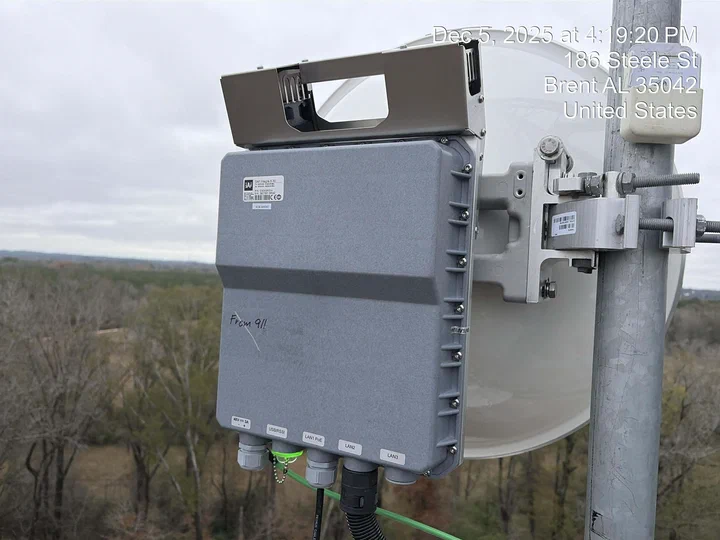
Mount hardware up. Antennas installed to rough azimuth off the stamped path drawing. Fine alignment done with both ends live, RSL measured against link-budget prediction, precision-aligned where tight tolerance is required. Cable runs pulled (fiber, DC, Cat6, or Ethernet tail to the IDU). Grounding and surge installed per R56. Reference engagement: 20+ alignments at first-sweep spec on the Streamline Internet Hendry County buildout.
Commissioning and 72-hour soak
Adaptive-modulation tuning. RSL verified against the path calculation. Link-budget margin checked against rain-fade design. 72-hour soak-test captures stability, BER, and error-second counts. Anything outside spec fixed before demob.
Handover
Walk the link with your NOC or engineer. Commissioning report delivered: path drawing, license records (if licensed), alignment log, RSL measurements, soak-test data, and as-built. You have everything your SLA auditor or successor contractor will ever need.
Built to standard. Licensed and inspected.
Every microwave backhaul link is held to the FCC rules for its band, the manufacturer spec, and the link-budget model. Marginal links don’t survive year-one weather.
FCC Part 101
Federal rules for fixed microwave service in the licensed bands (6, 11, 18, 23, 32, 38, 42 GHz). Every licensed link we install is coordinated through an FCC-approved frequency coordinator and operating under a granted license before on-air.
FCC Part 15
Unlicensed rules for 5, 24, and 60 GHz. EIRP caps, dynamic frequency selection (DFS), and interference-avoidance behavior respected at install time.
FCC Part 101 light-license (70 / 80 GHz)
Light-licensed E-band path registration. We register every E-band link with the designated coordinator before on-air.
ITU-R P.530
ITU recommendation for terrestrial line-of-sight link availability. Our rain-fade, fade-margin, and availability calculations are done per P.530 using ITU-R P.837 rain-rate data.
TIA-222-I
ANSI structural standard for antenna-supporting structures. Drives antenna loading, ice loading, and pedestal design on every tower-mounted dish.
Motorola R56 / IEEE 80
Grounding and bonding for communication sites. R56 default; stricter IEEE 80 on utility-grade microwave sites.
NFPA 780
Lightning protection. Surge suppressors on every cable, bonded to the tower ring, installed before the link is commissioned.
OSHA 1926 / ANSI A10.48
Safety at height. 100% tie-off, authorized rescue, site-specific safety plan.
Gear & certifications.
Equipment
- Platform-native alignment tooling for Aviat, SAF Tehnika, Siklu, Ubiquiti, Cambium, and Mimosa platforms
- Precision antenna alignment for tight-tolerance licensed microwave paths
- On-radio spectrum scan for pre-install interference survey (native tooling on Aviat, SAF, Siklu, Ubiquiti, Cambium, Mimosa)
- Power meters and variable attenuators for RSL verification
- Fusion splicers and light-source / power-meter sets for fiber IDU-to-network runs and insertion-loss testing
- Bit-error-rate testers for 72-hour soak testing
- FCC Part 101 licensing coordination through our in-scope filings partner
- Self-contained crew trailers: RF tooling, rigging, and spares
Certifications & insurance
- NATE ClimberSafe / SafetyLMS climbers on every install
- Platform-fluent installers on Aviat, SAF Tehnika, Siklu, Ubiquiti, Cambium, Mimosa
- FCC General Radiotelephone Operator License (GROL) on lead RF hands
- OSHA 10 / 30 compliant crews
- Fully insured: general liability and workers’ compensation
Questions we get a lot.
What is microwave backhaul?
A fixed point-to-point radio link between two sites, carrying network traffic through the air instead of fiber. Distances run from short urban hops (a few hundred feet between rooftops) to long-haul paths of 20 to 30+ miles on lower-frequency licensed bands.
Microwave is how most non-fiber-connected cell sites get their S1 traffic back to the core. It’s also how many WISPs feed distribution towers, how utility SCADA gets teleprotection data between substations, and how public-safety networks aggregate their repeater sites.
What's the difference between prosumer and carrier-grade microwave?
Price, build quality, and what the link is designed to carry.
Prosumer PTP (Ubiquiti airFiber, Cambium PTP, Mimosa B-series) runs 1,000 to 5,000 dollars per link. Works great for WISP distribution, small-business P2P, and best-effort traffic. Mostly unlicensed.
Carrier-grade microwave (Aviat WTM, SAF Integra, Siklu EtherHaul, Nokia) runs 10,000 to 60,000+ dollars per link. Built for 99.999% availability, sub-10 ms jitter, adaptive modulation with QPSK fallback, spatial diversity where required. Required for LTE/5G S1, utility teleprotection, and anything with an SLA.
Neither is “better.” They solve different problems at different price points. We’ll tell you which one fits your path and traffic.
Why does LTE/5G S1 backhaul need carrier-grade?
S1 (and N2 in 5G) is the signaling and user-plane interface between an eNodeB (base station) and the EPC (or 5GC) core. If that link drops, the cell drops. Operators build their cell sites against 99.999% availability targets (about 5 minutes of downtime per year). That availability isn’t achievable with prosumer gear because prosumer gear isn’t designed for it.
Carrier-grade microwave is designed for it. Adaptive modulation drops to a robust QPSK floor under rain fade rather than dropping the link. Forward error correction, automatic transmit power control, and (on heavy-weather paths) 1+1 hot-standby or spatial diversity keep the link up when the weather gets ugly.
Operators know this. RFPs for LTE and 5G transport backhaul specify carrier-grade equipment by name. We install to those specs.
Licensed or unlicensed, which do I need?
Depends on what the link is carrying and how much interference risk you can tolerate.
Use unlicensed if your traffic can tolerate occasional degradation, your path is short, and the RF environment is clean. Short WISP hops, business-to-business links, temporary connectivity. Ubiquiti airFiber 5XHD, Mimosa B5, and Cambium PTP 550 all work great here.
Use lightly-licensed E-band (70 / 80 GHz) for short high-capacity gigabit-plus hops where you need protection but don’t need fully coordinated Part 101 licensing. Common for small-cell backhaul and campus networks.
Use fully licensed Part 101 when the link is carrying SLA-grade traffic: LTE/5G S1, utility teleprotection, public-safety transport, or anything with uptime requirements that can’t afford a neighbor WISP jumping on the same unlicensed band next year.
We’ll walk you through which is right for your path during the requirement review.
What about rain fade?
Real issue. Rain attenuates microwave signal, and attenuation scales hard with frequency:
- 6 to 11 GHz: Minimal rain impact. Long paths practical (20 to 30+ miles).
- 18 GHz: Moderate rain attenuation. Good for metro links (5 to 12 miles).
- 23 GHz: Meaningful rain attenuation. Typical paths 3 to 8 miles.
- 38 to 42 GHz: Significant impact. Short paths, sometimes space diversity needed in wet climates.
- 60 GHz (V-band): Severe rain and oxygen absorption. Very short paths (under 1 mile).
- 70 / 80 GHz (E-band): Severe rain. Short paths but 1+ Gbps capacity.
We model every link against ITU-R P.530 using local rain-rate data (ITU-R P.837) for the actual site coordinates. If the math says the availability target isn’t achievable for the band you want on the path you have, we’ll tell you before the gear ships.
How does FCC licensing work for Part 101 paths?
Do you do ring topology and redundant backhaul?
What carrier-grade brands do you install?
Deep install experience across:
- Aviat Networks: WTM series, CTR, Eclipse. Licensed Part 101 microwave, strong U.S. and Canadian carrier presence.
- SAF Tehnika: Integra family, CFIP, Spectrum Compact alignment gear. Value-grade licensed microwave for WISP and utility work.
- Siklu: EtherHaul 60 / 70 / 80 GHz mmWave. Short-range high-capacity, great for small-cell backhaul and campus.
- Nokia: licensed microwave and Fastmile FWA. Primary partner on CBRS LTE sites via our relationship with The Edge Mile.
Long-term installer relationships with Aviat, SAF Tehnika, and Siklu mean we can give you honest vendor-neutral advice on what fits your job, not a sales pitch.
What prosumer platforms do you install?
How long does a microwave install take?
Physical on-site time:
- Single prosumer PTP link (unlicensed, short path): 1 to 2 days.
- Single carrier-grade licensed link (Part 101): 2 to 5 days install plus 72-hour soak test.
- Ring topology (4 to 8 nodes): 5 to 12 days, plus rotation between sites.
For licensed Part 101 work, add 6 to 12 weeks upfront for FCC coordination and frequency assignment before we can build. We’ll sequence that into your program timeline.
How much does a microwave link cost?
Fixed fee on defined scope, with unit rates and change orders for field conditions. Quoted against band, gear selection, path complexity, and licensing scope. Rough ranges:
- Unlicensed prosumer PTP (5/24 GHz, short path): low-to-mid five figures per link, mostly install labor.
- Lightly licensed E-band (70/80 GHz) short-range link: mid five figures per link.
- Fully licensed Part 101 carrier-grade link: mid-to-upper five figures per link, sometimes six for multi-band or diversity-protected paths.
- Ring topology multi-site: quoted per-node with program-rate discount.
Gear cost (radios, antennas, IDU) is typically a significant fraction of the total on carrier-grade links and a smaller fraction on prosumer. Send us the path and you’ll have a line-itemed quote inside a week.
Can you do TDM / E1 / legacy circuit emulation?
Do you do site design and install together?
What's your service area?
How do I get started?
Send us the two endpoint locations (addresses or coordinates), your traffic requirement (capacity, latency, availability SLA), and your target schedule. If you already know which vendor you want, tell us. If you don’t, we’ll walk you through it.
Request a quote here or call us at (763) 280-6050. Most customers have a quote inside a week.
Don’t see your question? Ask us directly. We answer every scoping call.
Related services.
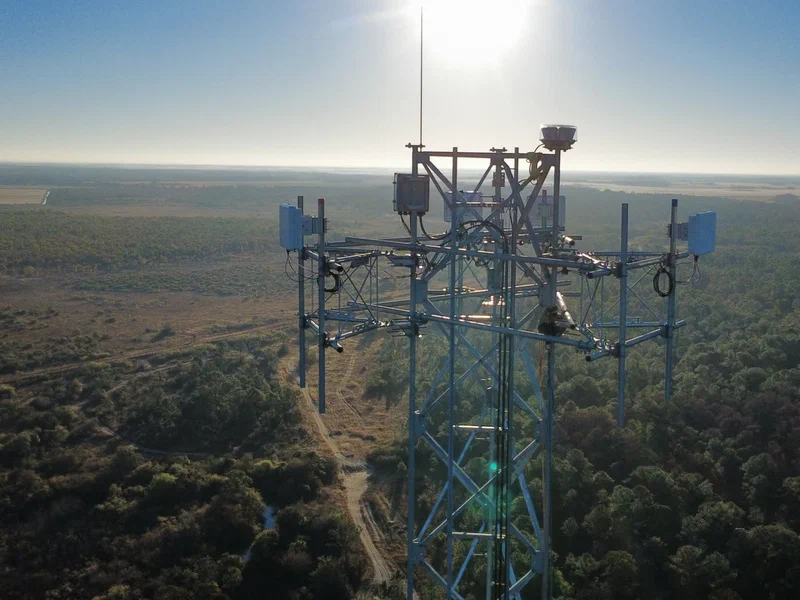
Sector & Backhaul
Sector antennas, backhaul dishes, horn arrays, aligned and sealed.
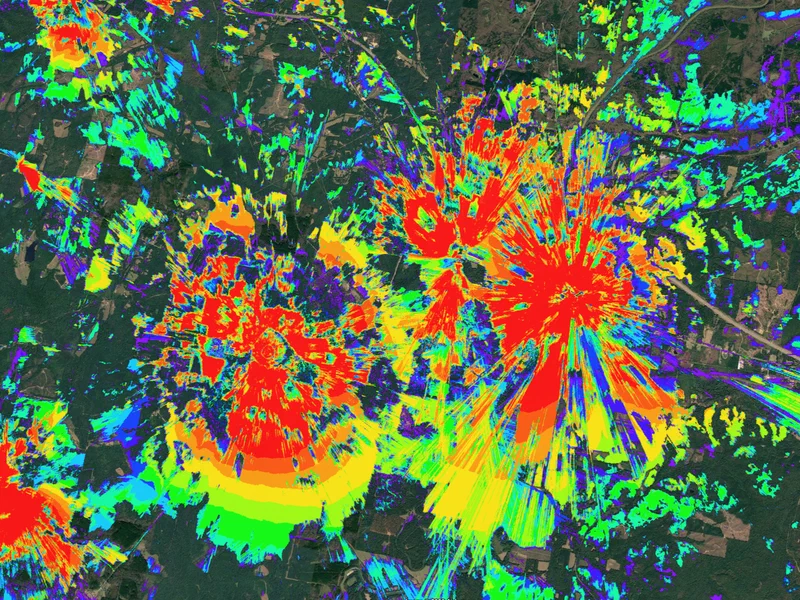
Site Design & RF Planning
Coverage planning, sector layouts, and pre-deploy mock-ups.
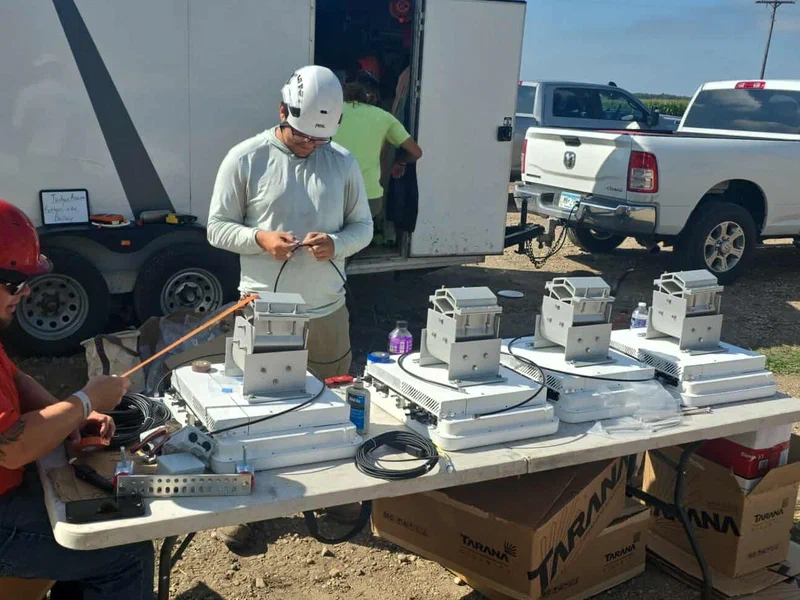
Antenna & Radio Install
Antennas, radios, fiber, DC, and Cat6. Ubiquiti, Cambium, Mimosa, Tarana, Nokia, and more.
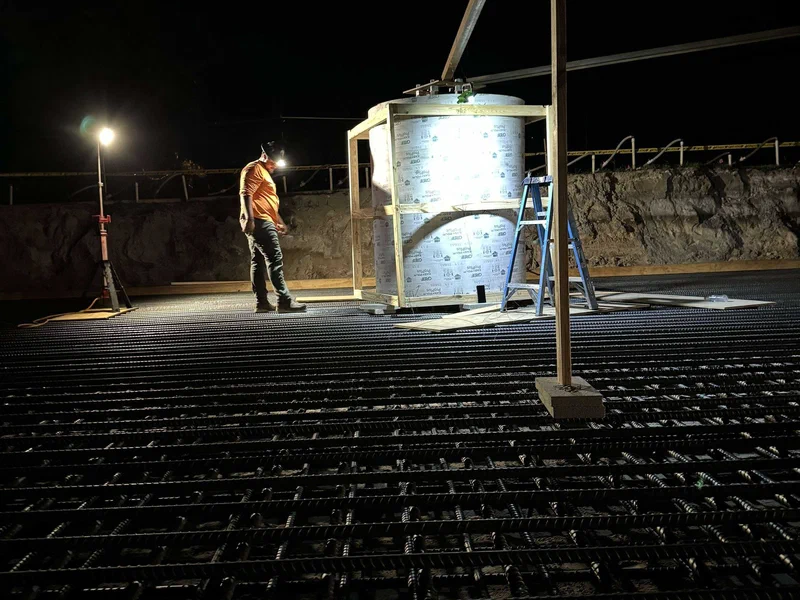
New Site Builds
Empty dirt to operational tower, one crew, one point of contact.
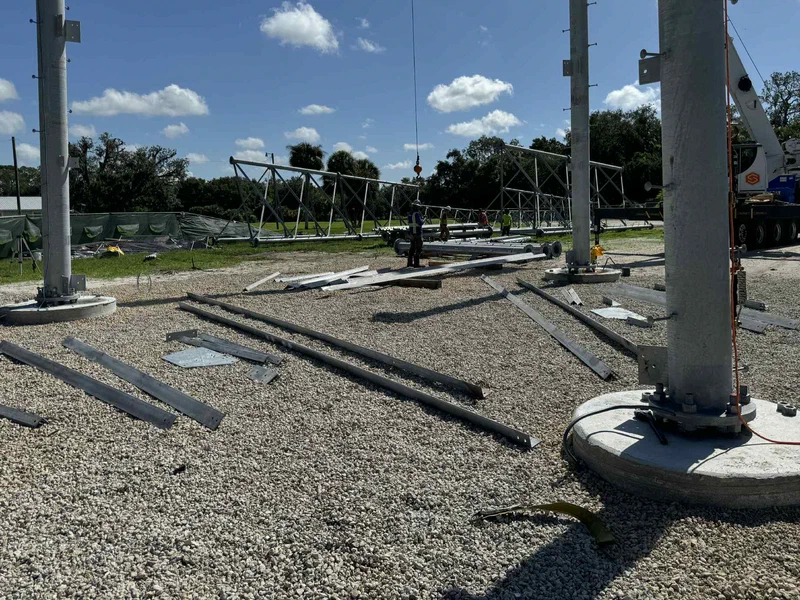
Tower Erection
Guyed, self-supporting, and monopole structures up to 300ft.
Page last updated July 30, 2026.
Tell us the site.
We'll bring the steel.
Send the location, tower type, scope, and timeline. We come back with a quote, a crew, and a schedule you can build a business around.