
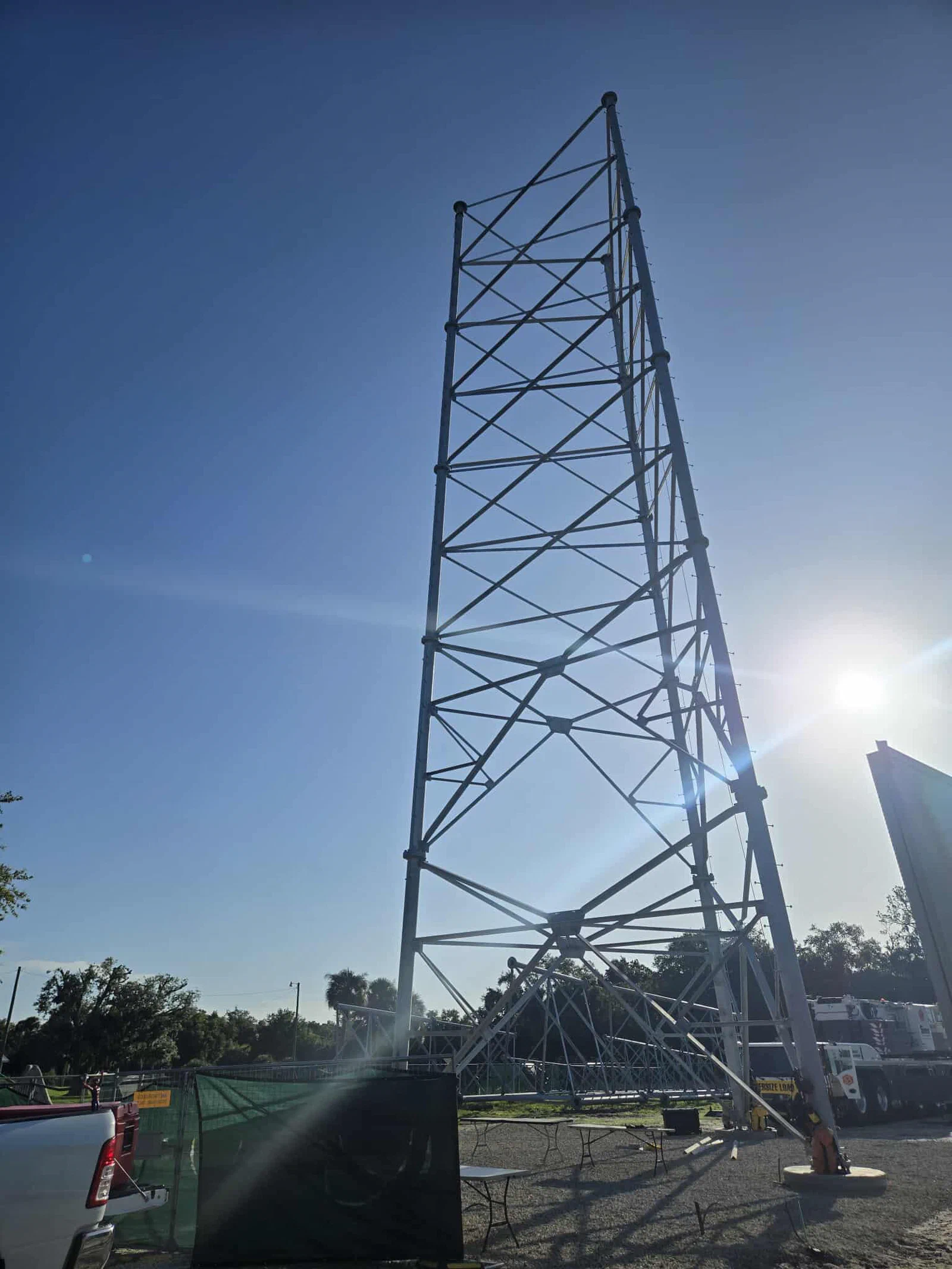
Self-Supporting Tower Construction: Foundation, Steel, and Turn-Up
Three-leg lattice towers, built from the foundation up by one crew. Vertical Axis builds self-supporting towers to 300 ft: drilled-pier or mat foundations poured to the stamped design, steel flown by crane in the manufacturer’s stacking sequence, bolted to A325/A490 spec, plumbed to TIA-222-I L/1500, and grounded to Motorola R56. Then the RF goes on. Recent work: 300-ft self-support towers with 4-carrier loading for Streamline Internet in Hendry County, Florida.
What's included.
Foundation, steel, plumb, RF, and closeout on one scope of work. Take the whole build, or hand us the part your program needs.
- Stamped tower drawings, foundation design, geotech report, and loading reviewed with your engineer of record before mobilization
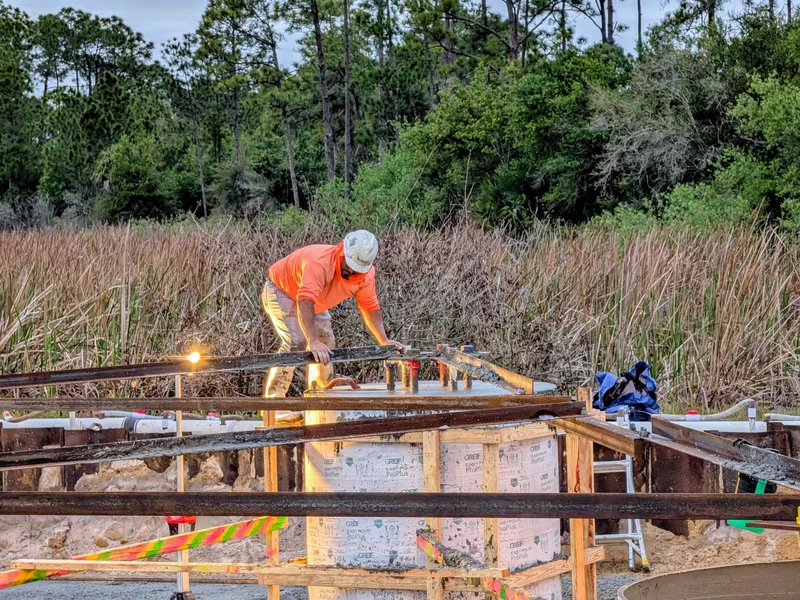
- Drilled-pier-per-leg or mat foundations excavated, formed, and poured to the stamped design
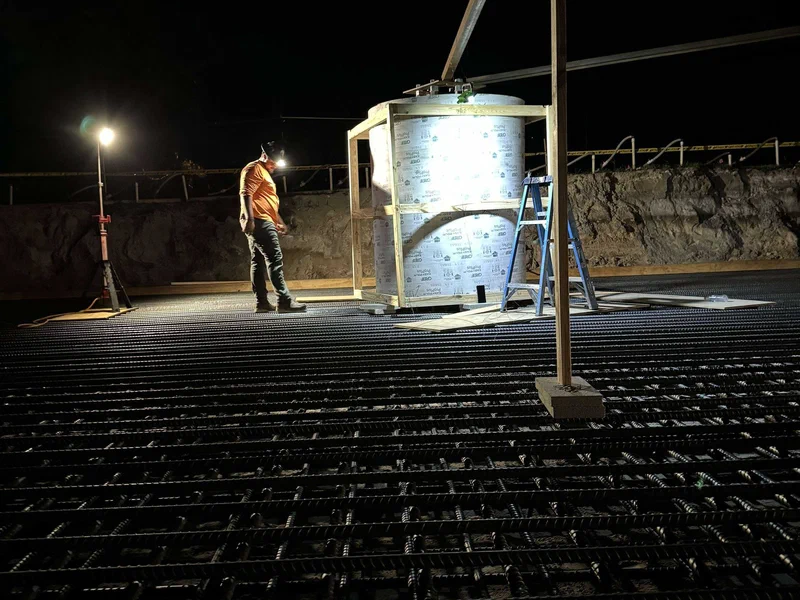
- Rebar cages tied on site; anchor-bolt templates set to elevation and bolt pattern
- Dewatering sequenced in on high-water-table sites with your dewatering contractor and geotech firm
- 4,000 to 5,000 PSI concrete, slump and air checked on arrival, cylinders cast for 7, 14, and 28-day breaks
- Bonded copper ground ring, cadwelded to every leg per Motorola R56
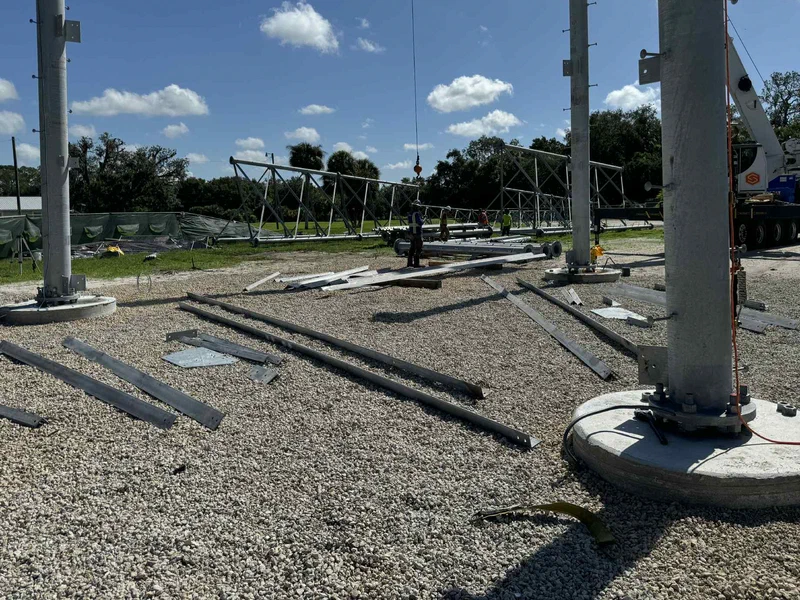
- Crane mobilization: 60 to 300 ton cranes sized to the heaviest pick and farthest radius
- Every section counted and inspected for shipping damage before anything flies
- Base section leveled on base nuts with a total station, not shimmed
- Sections flown in the manufacturer’s stacking sequence, each bolted off before the next leaves the ground
- ASTM A325 / A490 bolt-up with torque-calibrated tools and a per-connection torque log
- Plumb verified to TIA-222-I L/1500 (roughly 1 inch per 125 ft) with a total station
- Safety climb, ladder, lightning rod, and obstruction-light mast per manufacturer, ANSI A10.48, and FAA requirements
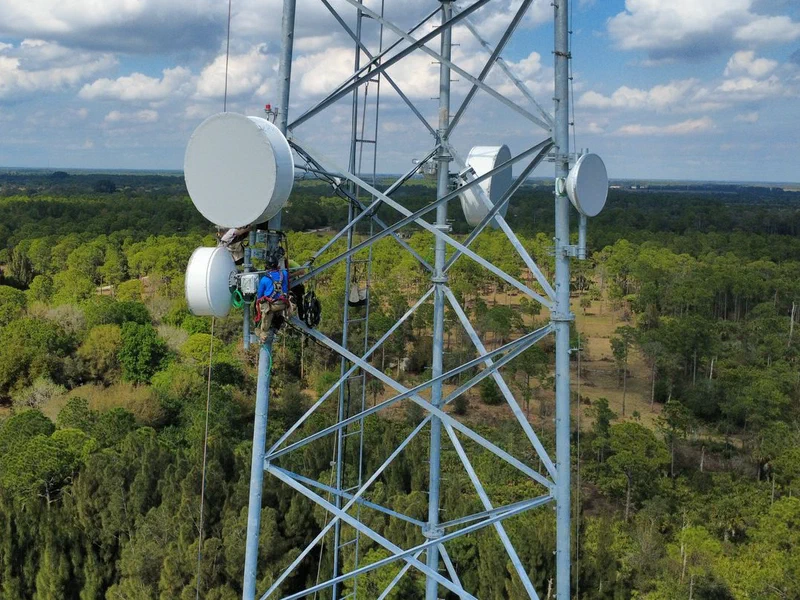
- Antenna, radio, and microwave dish install, with microwave alignment to the path design
- Closeout package: plumb report, torque log, break results, grounding record, photos, and owner closeout formats (SBA and Crown Castle packages delivered on Streamline)
They've taken four of our 4-carrier sites from ground-break all the way through turn-up, including 300-foot towers and massive foundations requiring hundreds of cubic yards of concrete. Projects that demand real precision and experience to get right.
Need a self-supporting tower on a real deadline?
Send your site details. We come back with a quote, a crew, and a schedule.
Freestanding steel. No guy radius. Built to carry the next tenant.
A self-supporting tower (SST) is a freestanding lattice tower: three steel legs tied together with cross-bracing, each leg bolted to anchor rods cast into the foundation. No guy wires means no guy-anchor radius to buy, lease, or fence. That’s why self-supporters are the default on tight parcels and on sites that have to carry heavy, multi-tenant antenna and dish loads for decades.
The trade is steel and concrete. A self-supporter carries every load through its legs and into the ground, so it takes more steel per foot than a guyed tower and a bigger foundation than its height suggests. Getting both right is the job: a foundation poured to the stamped design, and steel stacked, torqued, and plumbed to the drawing.
Self-supporting tower foundations.
Two families, both designed by the engineer of record from the site’s geotechnical report:
- Drilled pier per leg. One reinforced pier under each leg, commonly 3 to 6 ft in diameter and 8 to 20 ft deep, with the anchor-bolt cage held in a template so the leg pattern lands exactly where the drawing puts it.
- Mat foundation. One reinforced slab under all three legs, commonly 3 to 6 ft thick and 10 to 20 ft across on typical builds, and up to roughly 60 to 65 ft on heavy-loaded sites in poor soils or high wind zones.
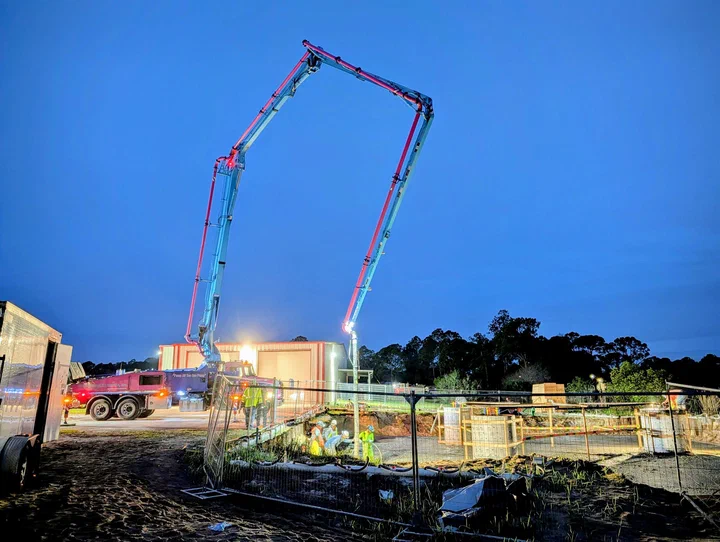
On Streamline Internet’s 300-ft, 4-carrier towers, the mats ran into the hundreds of cubic yards of concrete each, poured on a high water table with active dewatering and hot-weather pour discipline. More on the tower foundations page.
Stacking the steel.
Steel doesn’t fly until the engineer of record signs off on the cylinder breaks, generally the 28-day break for full loading. Then:
- Offload and QC. Every section counted against the packing list and checked for shipping damage. Bent members don’t go up.
- Base set. Base section leveled on base nuts with a total station and torqued in sequence per the drawing. The first plumb check happens here.
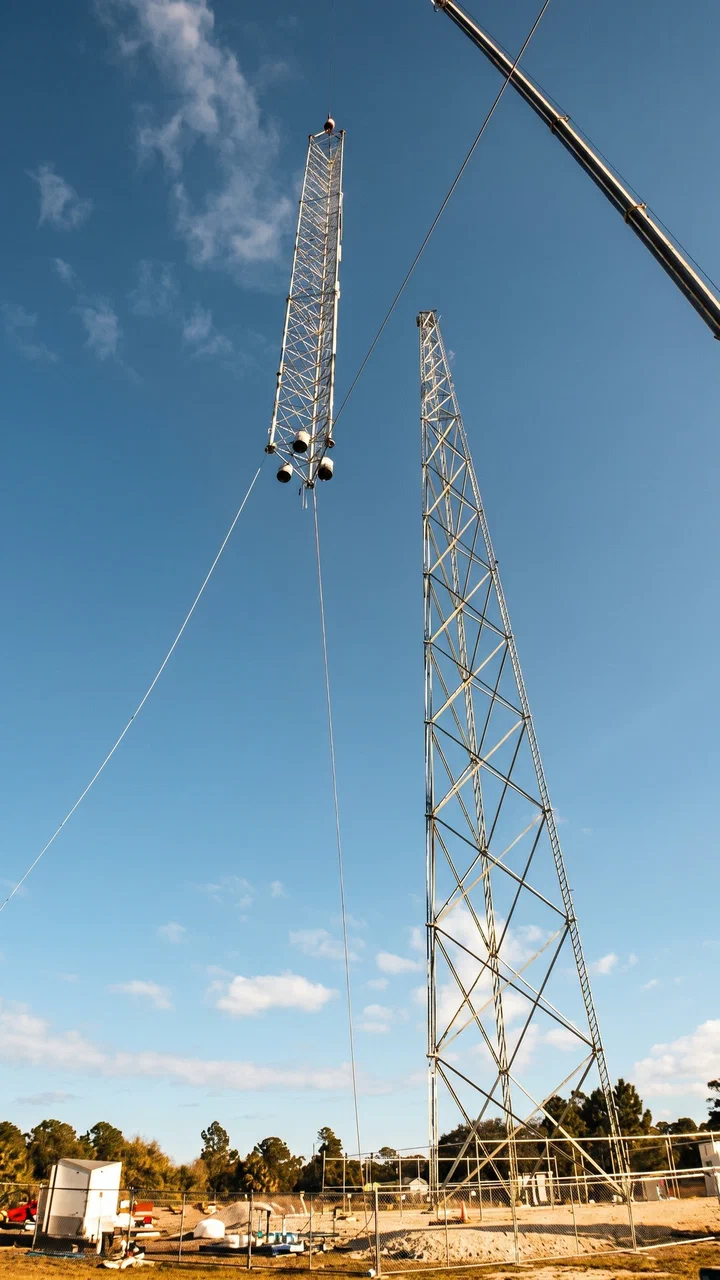
- Stacking sequence. Upper sections flown by crane in the manufacturer’s sequence. Each one is bolted off and torque-verified to ASTM A325 or A490 spec before the next leaves the ground.
- Plumb. Verified to TIA-222-I L/1500 with a total station on closeout. The crane leaves when the structure is standing, plumb, and signed off. Then the climbers go up with the RF.
Erection on a typical 200 to 300 ft tower runs 3 to 10 days once the crane is on the pad. More on the tower erection page.
Loaded for carriers, backhaul, and the next tenant.
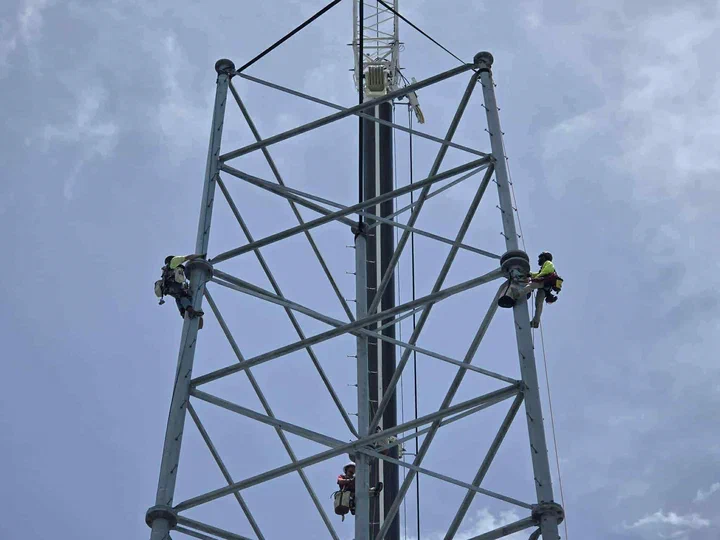
Most self-supporters exist to carry RF. The crews that stack the steel also mount the antennas, radios, and microwave dishes, run fiber, DC, and Cat6, bond everything to the ring, and align the links. On Streamline, that meant full Tarana radio installs and more than 20 microwave alignments, every one at spec on the first sweep.
One crew from the dig to turn-up means one schedule, one punch list, and one closeout package.
Self-supporting vs. guyed vs. monopole
The right structure comes down to height, loading, land, and how fast you need to be on air.
| Self-supporting | Guyed | Monopole | |
|---|---|---|---|
| Structure | Three-leg lattice, freestanding | Lattice mast held by guy wires | Single steel tube |
| Common heights | 100 to 300 ft | 200 to 500 ft | 60 to 200 ft |
| Land needed | Compact; no guy radius | Guy anchors out to roughly 60 to 80% of height | Smallest |
| Foundation | Drilled pier per leg, or one mat | Central pier plus guy-anchor blocks | Drilled pier, mat, or direct embed |
| Wins when | Land is tight and loading is heavy or multi-tenant | You need the most height per dollar on open land | Visual profile or speed to air matters most |
Pick self-supporting when the parcel can’t absorb a guy radius, when the tower has to carry heavy or multi-tenant loading, or when you want a simple climb and maintenance plan over the life of the asset. That was the call on Streamline’s 300-ft sites: the smaller compound kept the easements clean.
Pick guyed when you need maximum height and you have the land. Pick a monopole for urban or sensitive siting, or a direct embedment monopole when speed to air beats everything else.
Not sure which fits? Send us the site and the loading. We’ll tell you what we’d build and why.
How a self-supporter gets built.
From foundation dig to standing, plumbed steel, a typical 200 to 300 ft self-supporting tower runs roughly five to eight weeks, and most of that is concrete cure. Permitting and steel delivery set the start date.
Drawings, geotech, and lift plan
Stamped tower and foundation drawings, the geotechnical report, and equipment loading reviewed with your engineer. Crane class matched to the heaviest pick and farthest radius. Access, staging, and drop zone planned before mobilization.
Excavation, cage, and anchor template
Drilled piers or a mat excavated to the stamped drawing. Rebar cage tied and inspected, anchor-bolt template set to elevation and pattern, ground ring laid and cadwelded to every leg. Dewatering sequenced in where the water table demands it.
Pour, cure, and breaks
4,000 to 5,000 PSI per spec, slump and air checked on arrival, every lift vibrated, cylinders cast for 7, 14, and 28-day breaks. Drilled piers run 3 to 5 working days on site; mats about two weeks. Hot- and cold-weather pours follow ACI 305 and 306.
Offload and QC
Sections counted against the packing list, inspected for shipping damage, and hardware kits checked against the drawing. Sections pre-assembled on the pad where the drawing calls for it.
Base set and stacking
After the engineer approves the breaks: base section leveled on base nuts with a total station and torqued in sequence, then upper sections flown in the manufacturer’s stacking sequence, each bolted off and torque-verified before the next lift.
Plumb, climb safety, and lighting
Plumb verified to TIA-222-I L/1500 with a total station. Safety climb, ladder, lightning rod, and obstruction-light mast installed per manufacturer, ANSI A10.48, and FAA requirements.
RF, alignment, and closeout
Antennas, radios, and dishes mounted, aligned, weatherproofed, and bonded to the ring. Plumb report, torque log, break results, grounding record, photos, and owner closeout package delivered before demob.
Built to standard. Documented to prove it.
The structural, concrete, safety, and grounding frameworks every self-supporting tower we build is held to.
TIA-222-I
Current ANSI structural standard for antenna-supporting structures. Governs tower and foundation design loads, anchor rods, bolt grade, and the L/1500 plumb tolerance we verify on closeout.
ACI 318 / 305 / 306
Structural concrete code plus hot- and cold-weather concreting practice. Mix, cover, splices, vibration, cylinder testing, and cure on every pier and mat.
ASTM A325 / A490
High-strength structural bolt specs. Installed with torque-calibrated tools and verified per connection, logged in the closeout package.
OSHA 1926 Subparts CC and R
Crane and derrick safety, and steel-erection safety. Lift plans, signal persons, connection sequence, and fall protection during the stack.
ANSI/ASSP A10.48
Consensus safety standard for communication-tower work. Climber qualification, 100% tie-off, and authorized rescue on every crew.
Motorola R56
Grounding and bonding for communication sites. Copper ring cadwelded to every leg; stricter IEEE 80 practice when a utility engineer calls for it.
FAA AC 70/7460-1M / FCC Part 17
Obstruction marking and lighting, and antenna structure registration where the structure triggers FAA notification. Lighting mast and fixtures installed to the determination.
Gear & certifications.
Equipment
- 60 to 300 ton mobile cranes sourced through pre-qualified regional rental partners
- Excavators (Volvo EC and Sany SY series) and drilled-shaft auger rigs; spec rigs subcontracted for deep piers
- Anchor-bolt template rigs, laser levels, and total stations for elevation and plumb control
- Torque-calibrated impact tools, verified against a torque meter daily
- Concrete vibrators and cylinder molds for break tests
- Cadweld tooling and bare-copper inventory for ground rings
- Self-contained crew trailers: rigging, safety gear, bolts, and torque meters travel with us
Certifications & insurance
- OSHA 10 / 30 compliant crews
- NATE ClimberSafe and/or SafetyLMS-certified climbers
- Authorized climber rescue on every crew
- OSHA 1926 Subpart CC-qualified signal persons
- Competent-person certified for excavation and shoring per 1926 Subpart P
- Fully insured: general liability and workers’ compensation, umbrella coverage available
Self-supporting tower questions.
What is a self-supporting tower?
A self-supporting tower (SST, or self-supporter) is a freestanding lattice communications tower: three steel legs tied together with cross-bracing, carrying its own wind, ice, and equipment loads without guy wires. Each leg bolts to anchor rods cast into a drilled pier or a shared mat foundation.
With no guy-anchor radius, a self-supporter fits on a much smaller parcel than a guyed tower of the same height, and its lattice carries heavy, multi-tenant antenna and dish loads. They’re a standard choice for 100 to 300 ft WISP, utility SCADA, and wireless sites where land is tight.
How tall can a self-supporting tower be?
Self-supporting or guyed: which is right for my site?
Self-supporting when the parcel can’t absorb a guy radius, when the tower has to carry heavy or multi-tenant loading, or when you want a simple climb and maintenance plan over the life of the asset. Guy anchors typically sit out at 60 to 80 percent of tower height, so a guyed tower needs a lot more land and easement.
Guyed when you need the most height per dollar and you have the land. Guyed lattice is the most cost-effective way to get tall, commonly 200 to 500 ft.
On Streamline’s 300-ft sites, self-support was the call because the smaller compound kept the easements clean. Send us the site and the loading and we’ll tell you what we’d build and why.
Self-supporting tower or monopole?
What foundation does a self-supporting tower need?
Either a drilled pier under each leg or a single mat foundation under all three, as designed by the engineer of record from the site’s geotechnical report:
- Drilled piers: commonly 3 to 6 ft in diameter and 8 to 20 ft deep.
- Mats: commonly 3 to 6 ft thick and 10 to 20 ft across, up to roughly 60 to 65 ft on heavy-loaded sites in poor soils or high wind zones.
We push for a geotech survey with more than one bore, because a single bore can miss the rock pockets and saturated sand lenses that force a redesign mid-pour. Full detail on the tower foundations page.
How long does it take to build a self-supporting tower?
From foundation dig to standing, plumbed steel, plan on roughly five to eight weeks for a typical 200 to 300 ft self-supporter:
- Foundation: 3 to 5 working days on site for drilled piers, about two weeks for a mat.
- Cure: steel waits for the engineer of record’s sign-off on the cylinder breaks, generally the 28-day break for full loading.
- Erection: 3 to 10 days once the crane is on the pad.
RF install and alignment follow the steel. Permitting, FAA determinations, and steel delivery set the start date, so we build the schedule around them.
How much does a self-supporting tower cost?
Fixed fee on a defined scope, with unit rates and change orders for field conditions. For a 180 to 300 ft self-supporting tower, usable order of magnitude:
- Foundation package: usually mid five to low six figures, driven by rebar tonnage and concrete volume.
- Steel erection: typically six figures, driven by steel tonnage and crane logistics.
- Turnkey build (foundation, steel, RF, grounding): typically six figures, with foundation design and steel tonnage driving most of the spread.
Site access, soils, haul distance, and permits are the other variables. Send us the drawings and you’ll have a line-itemed quote inside a week.
What do you need from us to quote it?
Do you handle permits, FAA filings, and the access road?
Can you put the antennas and microwave on it too?
Do you work on existing self-supporting towers?
Where do you build?
How do I get started?
Send the site (address or coordinates), the stamped tower and foundation drawings if you have them, equipment loading, and your target schedule.
Request a quote here or call us at (763) 280-6050. Most customers have a line-itemed quote within a week.
Don’t see your question? Ask us directly. We answer every scoping call.
Related services.
Foundations & Civil
Excavation, rebar, concrete, grading, fencing, and ground rings.
Tower Erection
Guyed, self-supporting, and monopole structures up to 300ft.
New Site Builds
Empty dirt to operational tower, one crew, one point of contact.
Microwave Alignment
New links, storm re-aligns, and low-RSL fixes. Both ends peaked against the link budget.
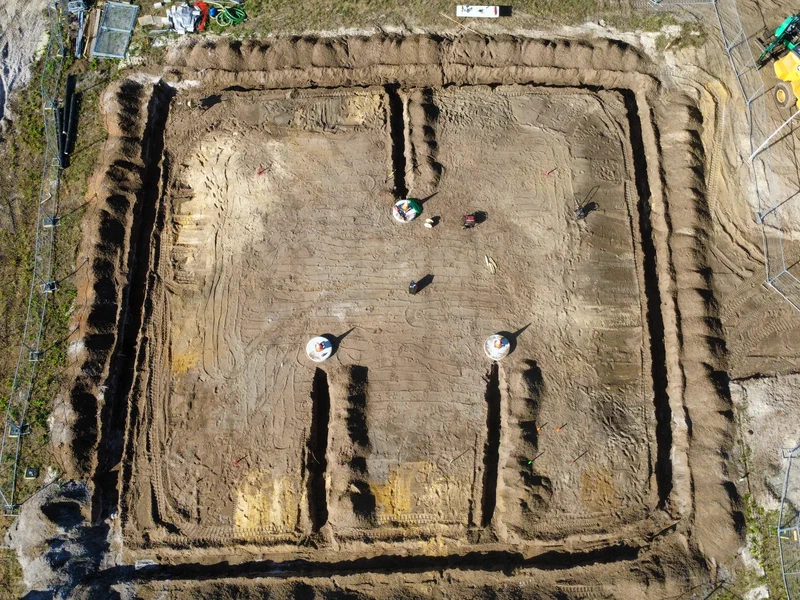
Grounding & Cadwelding
Ground rings, exothermic welds, bonding to NEC and manufacturer spec.
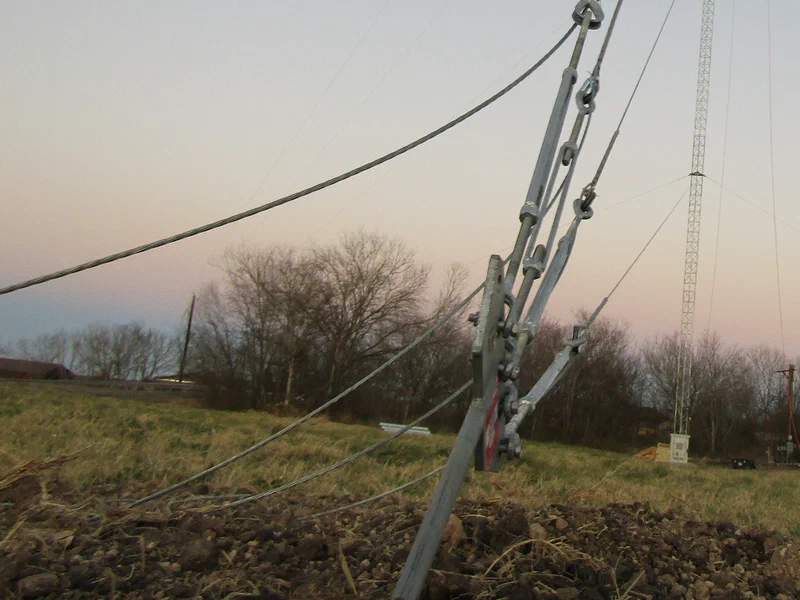
Plumb & Tension
Verify plumb, tension guys, correct storm-displaced structures.
Page last updated October 28, 2026.
Tell us the site.
We'll bring the steel.
Send the location, tower type, scope, and timeline. We come back with a quote, a crew, and a schedule you can build a business around.