
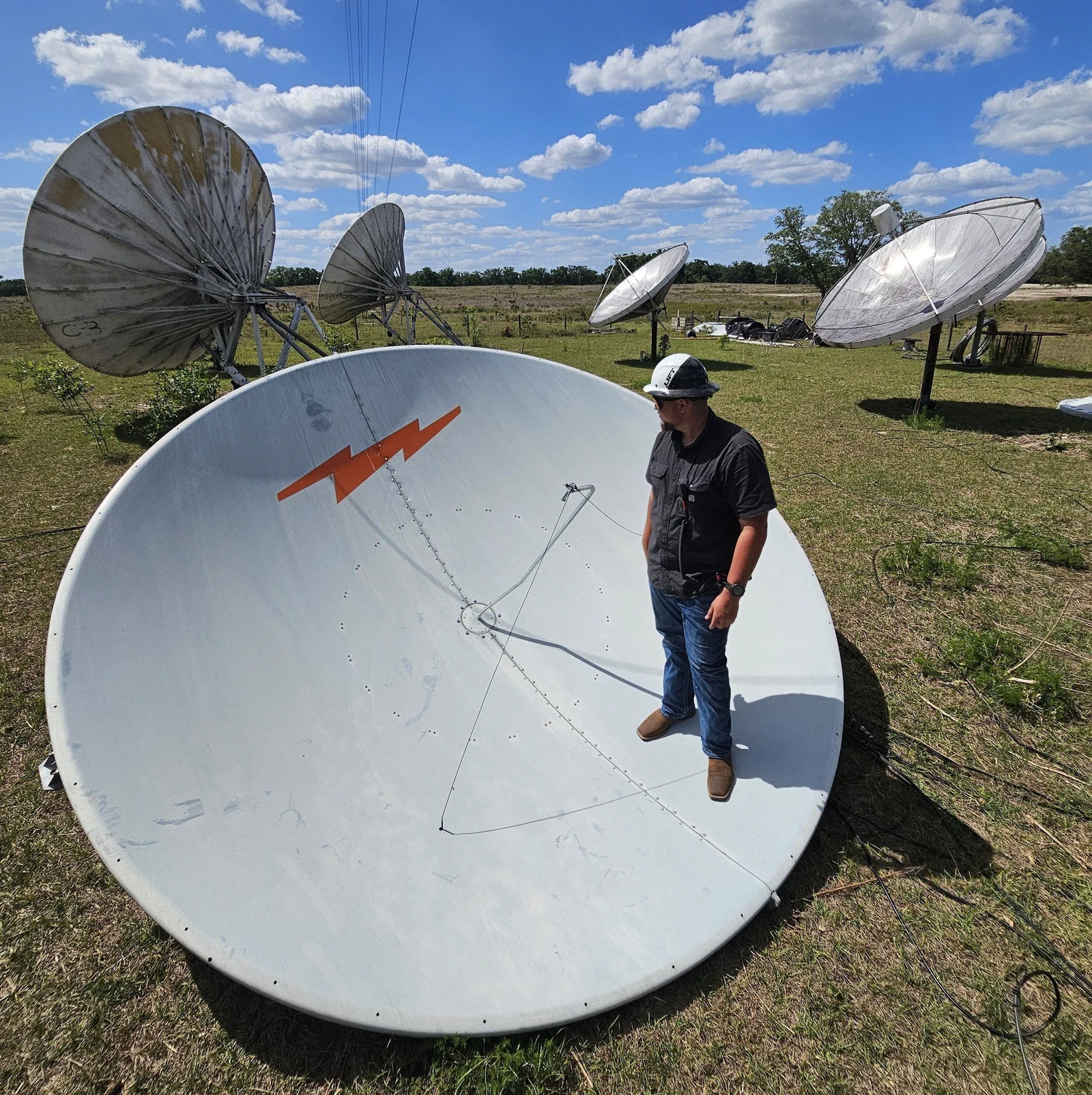
Tower Decommissioning, Removal & Site Restoration
Taking a tower down is a harder job than building one. Antennas off, feedlines out, steel on the ground, foundations capped or removed, the site seeded back to grade, and every FCC and FAA filing closed out. Guyed, self-support, and monopole structures, up to the height we’ve built. Full lifecycle, documented.
What's included.
The full scope of taking a communications structure out of service. Equipment off, steel down, foundation handled, paperwork closed, and the site returned to the state your land-use agreement specifies.
- Pre-demolition site assessment: structural condition, guy-system state, foundation condition, access
- Hazmat review: legacy lead paint on aviation-orange steel, mercury vapor lighting, PCB risk on older broadcast sites
- FCC Antenna Structure Registration (ASR) cancellation coordination and filing
- FAA final notification and obstruction-light NOTAM closeout when applicable
- FCC Form 854R closeout filings for owner-dismantled registered structures
- Tribal THPO and state SHPO consultation coordination on federal or historic sites
- Stormwater and NPDES Construction General Permit coordination where site disturbance triggers it
- Equipment decommissioning: antennas, radios, dishes, mount hardware removed in controlled sequence
- Feed-line removal: legacy and modern cabling (fiber, DC, Cat6, plus any existing passive feed-line) pulled, bundled, and staged for disposition
- Client-directed equipment disposition: return to owner, resale prep, or recycling through our partner network
- Guy-wire progressive detensioning and controlled section removal on guyed towers
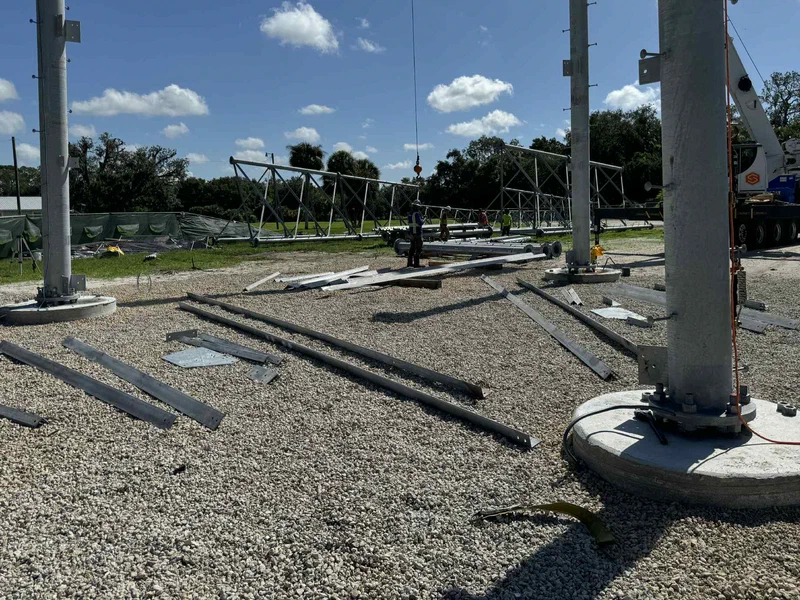
- Self-support tower crane-down and section disassembly
- Monopole removal: base-flange unbolt and crane-down, or hot-cut and controlled felling where site layout allows
- Copper salvage and scrap-value accounting (grounding ring, feed-line center conductors, bus bars)
- Foundation handling: cap-in-place, partial break-out, or full removal per the stamped scope
- Guy-anchor removal or capping on guyed-tower sites
- Equipment shelter, cabinet, and generator decommissioning and removal when in-scope
- Fence, gate, and compound hardware removal or retention per owner preference
- Site grading, topsoil restoration, and reseeding to the stamped restoration plan
- Hauling and disposal: structural steel to recycler, concrete to crush site, hazmat to licensed facility
- Closeout documentation: ASR cancellation confirmation, as-left site drawings, scrap-value accounting, photo record
Need tower decommissioning, removal & site restoration on a real deadline?
Send your site details. We come back with a quote, a crew, and a schedule.
Taking a tower down is a different skillset than putting one up.
A new build is linear: civil, steel, RF, commission. Every member goes up as an engineered step. The structure gets stronger by the hour.
A decommissioning runs the opposite direction against a structure that has been weathering in place for 15, 25, or 40 years. The original crew is long gone. The stamped drawings may be partial, out-of-date, or missing. Fasteners are corroded. Guy cables have crept. Welds have a service history nobody documented. The tower is getting weaker as you work on it, not stronger, and the last crew to touch it is the crew responsible for bringing it down without anyone getting hurt.
That’s where this service lives. Our foremen have run decommissioning scope since the Waldrop Wireless days. The October 2019 field note (“Tower disassembled, trailer packed up and on to the next job”) is one job of many. Every decom is planned against the structure in front of us, not the one that was built. Guy-wire tension measured before the first cable is cut. Bolt condition checked before a crane pulls a section. Hazmat review completed before torches light off. The job runs on the condition of the steel, not on the crew’s schedule pressure.
Guyed, self-support, and monopole each come down differently.
There is no single decommissioning procedure. The method is set by the structure:
- Guyed towers come down by progressive detensioning of the guy system, paired with crane-assisted or gin-pole section removal. You cannot just cut a guy cable. A tensioned guy releases stored energy in every direction. We measure tension before touching anything, detension in engineered stages against the guy-tension pattern, and sequence section removal so the structure never carries load in a geometry it wasn’t designed for.
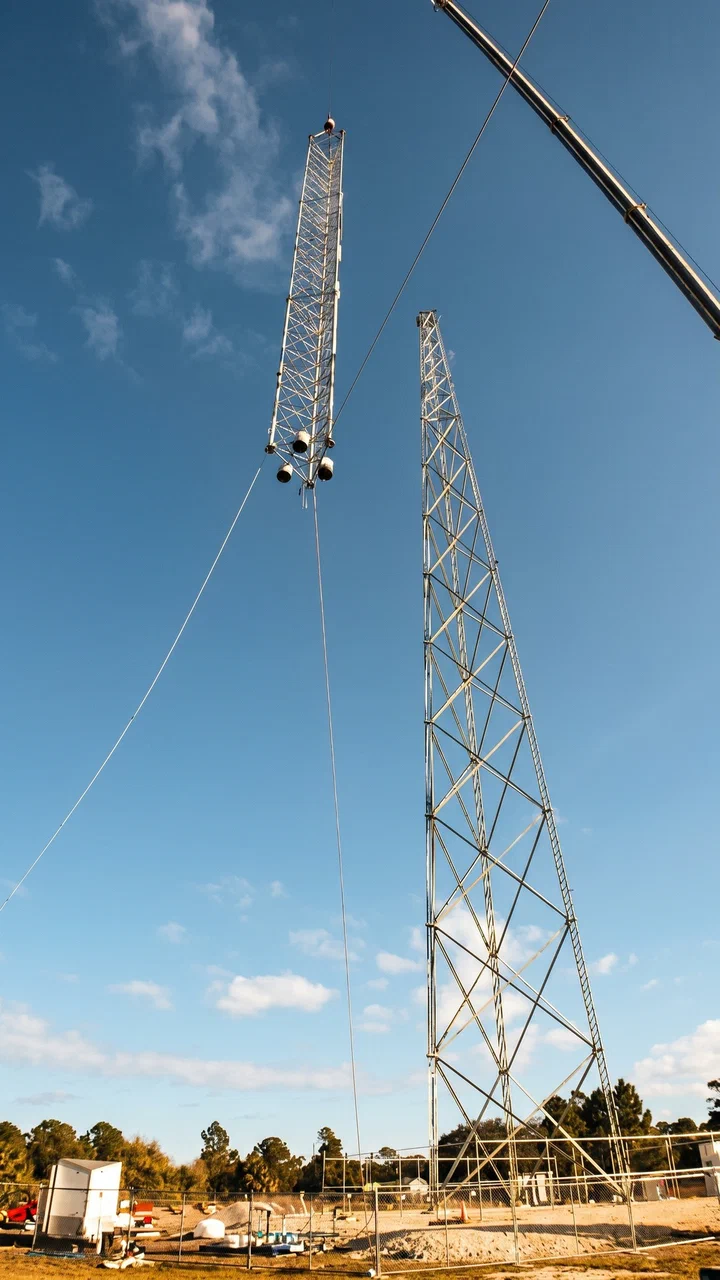
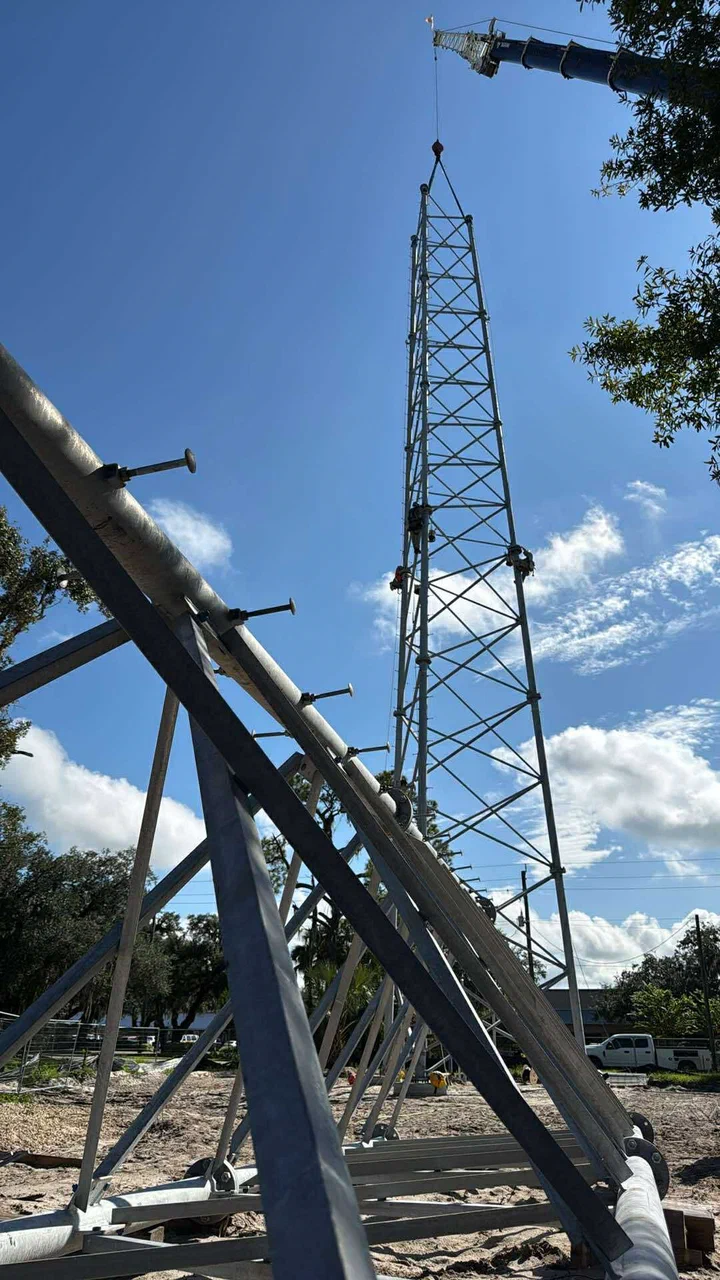
- Self-support towers come down by crane unbolt and section removal from the top down. Bolts verified for condition before load transfer. Each section rigged, lifted clear, and set on the ground. On sites without crane access, section-by-section gin-pole removal is possible but slow.
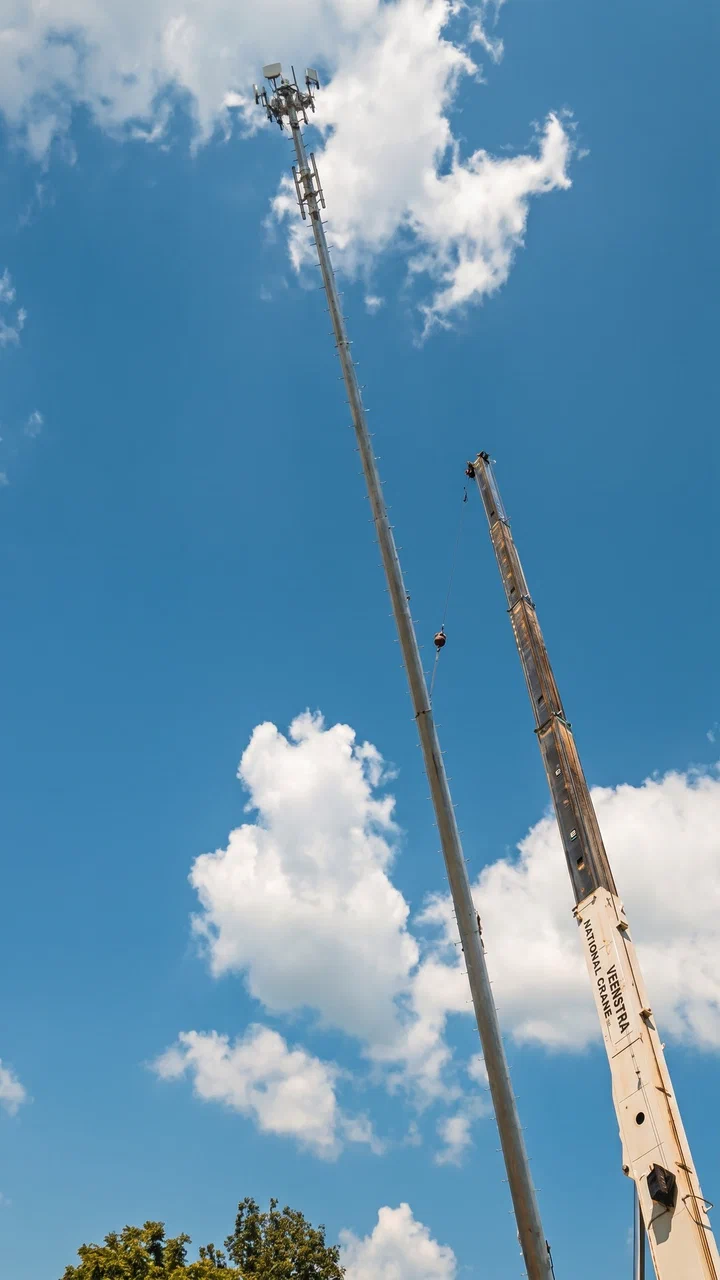
- Monopoles come down either by base-flange unbolt and full crane-down (the standard method on bolted-base poles under roughly 150 ft), or by hot-cut and controlled felling where the site has the drop zone for it. Controlled felling is efficient on remote sites with space, but requires a stamped felling plan and a cleared drop radius.
- Direct-embedment monopoles come down by excavating the embedded portion after the aerial section is removed. If the backfill was flowable fill, excavation is clean. If it was structural concrete, it runs closer to a foundation-removal scope. See our direct-embedment service for the build side of that work.
We pick the method on-site against the structure, the access, and the owner’s restoration preference.
Not every tower we take down is in the FCC database.
Communications structures have an ASR number, a lighting plant, and a federal closeout. A lot of the towers that need to come down don’t.
Training towers. Rappel towers. Confidence courses. Range towers. Meteorological towers. Legacy microwave stubs on a facility that no longer uses them. No Form 854R. No NOTAM closeout. Different hazmat, different drop plan, different person signing the restoration.
Those still come down the same way: measured, sequenced, and planned against the steel in front of us, not against a drawing that may not exist. On a military installation the extra layer is access, escorts, and a drop zone the airfield or range can live with. On a training tower the extra layer is often unknown fasteners, undocumented field-welds, and a structure that was never built to TIA-222 in the first place.
We take that work. Federal, military, and government is the industry page for installation access. This page is the teardown.
The paperwork is a service. Not a line item you skip.
A lit, registered communications structure sits inside a federal regulatory envelope. Taking it out of service means taking it out of that envelope too, which is a paperwork scope as real as the steel.
- FCC ASR cancellation. Every registered structure has an Antenna Structure Registration number. Leaving that number active on a structure that no longer exists is a Part 17 compliance problem. We coordinate or file the cancellation with the FCC (Form 854R is common for owner-dismantled structures) and confirm the registration is closed in the CDBS / ULS system before we demob.
- FAA final notification. Structures that triggered an FAA 7460-1 during construction often warrant a final-status notification when the structure is removed, especially for sites near public-use airports or airspace surfaces.
- NOTAM closeout. If the obstruction-lighting plant was reporting to FAA Flight Service, we sequence the final NOTAM cancellation against the actual de-energization date, not the project-plan date.
- SHPO and THPO consultation. Structures on federal land or on sites with a recorded historic-preservation review often need consultation with the State Historic Preservation Office or the tribal Tribal Historic Preservation Office before demolition begins. We coordinate the consultation and hold construction until the review returns.
- Stormwater. Site disturbance above the federal NPDES threshold (typically 1 acre) triggers a Construction General Permit, including a SWPPP and documented BMPs during grading and restoration. Common on larger self-support and broadcast-site decoms.
If you’re an operator who is used to owning the paperwork in-house, we can work inside that workflow. If you’d rather hand us the whole lifecycle, the filings desk runs it end-to-end.
Equipment disposition and scrap-value accounting.
A decommissioned tower generates three things with value: reusable radio and RF gear, recyclable copper and steel, and hazmat that has to be paid to dispose of. Our default is to treat all three transparently.
- Radios, antennas, and ODUs come down first, in controlled rigging, not thrown to the ground. You get them back for re-deployment, for resale, or for staged recycling. Serial-number inventory delivered with the closeout.
- Copper lives in the grounding ring, the legacy feed-line center conductors, the power feeds, the antenna shunts, and (on older sites) in the bus bars inside the equipment shelter. Copper scrap is heavy enough on a typical decom that the recovered value materially offsets project cost. We bale, weigh, and credit against the quote.
- Structural steel is a recyclable commodity. We haul to a mill-grade recycler, not a dump, and the scrap credit is line-itemed in the final accounting.
- Hazmat is the other side: lead paint on aviation-orange-and-white steel (anything marked under old AC 70/7460-1 prior to the unpainted-strobe era), mercury vapor lamps in legacy obstruction lighting plants, PCB-risk equipment on older broadcast and utility transformer sites, and occasionally asbestos in legacy equipment shelters. We test before we cut, contain where the exposure rating demands it, and haul to licensed facilities with manifests you keep on file.
The closeout accounting shows the scrap credits, the hazmat disposal charges, and the net settlement against the project quote. No mystery accounting.
How it goes.
A typical tower decommissioning runs 1 to 3 weeks on-site, driven by structure height, foundation scope, and access. Paperwork lead time (ASR cancellation coordination, SHPO or THPO consultation, stormwater permits) is sequenced in parallel before mobilization.
Site assessment and decommissioning plan
Foreman on site, drawings in hand (whatever drawings exist). We walk the structure, measure current guy tension on guyed towers, verify foundation condition, inventory remaining equipment, and flag hazmat review requirements. If the stamped drawings are missing, we field-measure the structure and coordinate with a PE for the decommissioning sequence. Output is a documented demo plan, including crane or rigging method, waste-stream plan, and site-restoration target.
Paperwork and regulatory coordination
FCC ASR cancellation sequence set against the demobilization date. FAA and FAA Flight Service coordination for lighting-plant NOTAM closeout. SHPO or tribal THPO consultation initiated where federal land, historic sites, or tribal jurisdiction applies. Stormwater NPDES Construction General Permit filed where site disturbance triggers it. Local demolition permit pulled where the jurisdiction requires one.
Hazmat review and containment plan
Lead-paint testing on aviation-painted steel. Mercury-containing lamps inventoried in the lighting plant. Asbestos and PCB review on older equipment shelters, cabinets, and transformers. Containment plan set against the test results. Crews assigned to the exposure rating of the work.
Equipment decommissioning
Antennas, radios, dishes, and ODUs come down first, in controlled rigging. Feed-lines (fiber, DC, Cat6, plus any legacy passive feed-line on the structure) pulled, bundled, and staged. Equipment shelter or cabinet gear decommissioned against client disposition preference. Serial-number inventory recorded. Client-return gear crated and shipped, resale-track gear staged, recycling-track gear palletized.
Structural teardown
Method per the decommissioning plan. Guyed towers: progressive detensioning of the guy system in engineered stages paired with section removal. Self-support: bolts verified, sections rigged and crane-down from the top. Monopole: base-flange unbolt and crane-down, or hot-cut and controlled felling where the site allows. Every section tagged with its steel-grade for recycling. Nothing dropped uncontrolled.
Foundation and anchor handling
Scope-dependent. Cap-in-place (foundation surface broken to three feet below grade and covered with native fill) is common where the owner plans to reuse the site. Partial break-out (foundation demo to four to six feet below grade, rebar removed, hole backfilled) is the NEPA-common middle path. Full removal (foundation demo to original subgrade, concrete hauled, native fill and compaction to grade) is called for on restoration-to-agricultural or restoration-to-historic-use sites. Guy anchors removed or capped to match the foundation scope.
Hauling and site restoration
Structural steel to a mill-grade recycler. Concrete to a crush-and-recycle facility where possible. Hazmat to licensed disposal with manifests retained. Fence, gate, and compound hardware removed or retained per owner preference. Site graded to the stamped restoration target. Topsoil replaced, reseeded with the specified seed mix, and erosion-controlled per the SWPPP if one was in effect.
Closeout and documentation
ASR cancellation confirmation from the FCC. FAA final-status notification receipt where applicable. Scrap-value accounting reconciled against the project quote. Hazmat manifests delivered. As-left site drawings and restoration photos delivered. NOTAM final-cancel confirmation from Flight Service. Your land-use file, your insurance file, and your successor owner have everything they need.
Built to standard. Removed to code.
Decommissioning is regulated work across OSHA, the FCC, the FAA, the EPA, and state and tribal historic-preservation frameworks. Every layer is in scope.
OSHA 1926 Subpart CC
Federal crane and derrick standard. Pole and section removal counts as a crane lift. Qualified signal person and qualified operator on every lift, lift plan on every pick.
OSHA 1926 Subpart P
Federal excavation standard. Foundation removal and guy-anchor break-out count as excavation. Competent person on site, protective-system plan for any excavation over 5 ft.
OSHA 1926 Subpart R
Steel erection and dismantling. Governs the rigging, bolt removal, and section handling on self-support and guyed teardown.
ANSI / ASSP A10.48
Consensus safety standard for communication-tower work. Covers rigging-down operations the same as rigging-up. 100% tie-off, authorized rescue, site-specific safety plan on every climb.
TIA-222-I
ANSI structural standard for antenna-supporting structures. Governs the condition assessment on live-structure decommissioning, including guy-tension verification and member-condition review before load transfer.
FCC Part 17 / ASR
Antenna Structure Registration rules. Registered structures require ASR cancellation filing when removed. Form 854R common for owner-dismantled structures. Registration must be closed in the FCC ULS / CDBS before we demobilize.
FAA AC 70/7460-1M
Current FAA advisory circular on obstruction marking and lighting. Final NOTAM cancellation sequenced against actual de-energization of the lighting plant. Final-status notification filed with FAA on structures that triggered 7460-1 at construction.
EPA RCRA / 40 CFR 260–279
Federal hazardous-waste rules. Lead-paint waste, mercury-vapor lamps, PCB-risk equipment, and asbestos abated and disposed of through licensed facilities under documented manifests.
EPA NPDES / Construction General Permit
Federal stormwater permit for construction sites disturbing 1+ acre. SWPPP, BMPs, and inspection records maintained through restoration on larger self-support and broadcast-site decoms.
NHPA Section 106 / SHPO / THPO
National Historic Preservation Act consultation. State Historic Preservation Office or tribal THPO review coordinated on federal-land, historic, or tribal-jurisdiction sites before demolition begins.
State and local demolition codes
Jurisdiction-specific demolition permits pulled where required. Local stormwater, haul-route, and disposal rules followed. No shortcuts on municipal paperwork.
Gear & certifications.
Equipment
- 60–80 ton mobile cranes for section removal; pre-qualified regional partners in every crew hub region
- Gin-pole rigging inventory for remote sites without crane access or tight drop zones
- Oxy-fuel and plasma cutters for welded connections and hot-cut work on monopole removals
- Hydraulic shears and breakers for foundation break-out and guy-anchor removal
- Load cells for guy-tension measurement during progressive detensioning
- Copper baling, weighing, and recovery equipment
- Hazmat PPE, containment tarping, and abatement tooling for lead-paint and mercury work
- Excavators, skid steers, and compactors for foundation removal and site grading
- Transport trailers for scrap steel and processed concrete
- Self-contained crew trailers: decommissioning-specific rigging, cutting, and recovery gear
Certifications & insurance
- NATE ClimberSafe and SafetyLMS-certified climbers on rigging-down operations
- OSHA 1926 Subpart P competent person for excavation (foundation and anchor removal)
- OSHA 1926 Subpart CC qualified signal person and qualified operator on every crane lift
- EPA RRP (Lead Renovation, Repair, and Painting) certification for lead-paint scope
- Hazmat operations training on all decommissioning leads
- ASR filings coordination via our in-scope FCC partner
- Fully insured: general liability, workers’ compensation, and umbrella coverage
Questions we get a lot.
What does a full tower decommissioning include?
The full lifecycle, not just the steel. Default scope:
- Equipment decom — antennas, radios, ODUs, and feed-lines down first, in controlled rigging.
- Structural teardown — guyed, self-support, or monopole, method set against the structure.
- Foundation handling — cap-in-place, partial break-out, or full removal per your land-use agreement.
- Hazmat handling — lead paint, mercury lamps, PCB-risk equipment, asbestos abated through licensed disposal.
- Paperwork — FCC ASR cancellation, FAA final notification, obstruction-light NOTAM closeout, SHPO or tribal THPO consultation where applicable, stormwater permit closeout.
- Site restoration — grading, topsoil, reseeding, and fence disposition to the stamped target.
- Scrap-value accounting — copper, steel, and salvage-recovered gear credited back on the closeout.
You can carve any piece out of scope. Most owners hand the whole lifecycle to us because the coordination cost of splitting the paperwork is higher than the scope itself.
How long does a tower decommissioning take?
On-site time depends on structure height, foundation scope, and access:
- Small WISP or utility monopole (60 to 150 ft) with cap-in-place foundation: 3 to 5 days.
- Standard self-support or guyed tower (150 to 300 ft) with partial foundation break-out: 1 to 2 weeks.
- Tall broadcast or comms tower (300 to 500+ ft) with full foundation removal and restoration: 2 to 4 weeks.
Paperwork runs in parallel before mobilization. ASR cancellation coordination and SHPO / THPO consultation are the two items that can extend the total project timeline (commonly 4 to 8 weeks of lead time for the historic review on federal or tribal jurisdiction sites). We sequence those so they don’t become the critical path.
Who handles the FCC ASR cancellation?
What about the obstruction lighting — when does the final NOTAM close?
What happens to the equipment we had on the tower?
Your call. Three common dispositions:
- Return to the owner. Antennas, radios, ODUs, and any salvageable gear come down in controlled rigging, get serialized, crated, and shipped back to your depot or a location you specify.
- Resale prep. For gear with residual market value (current-generation Tarana, Ubiquiti, Cambium, Nokia), we can stage for direct resale or for a broker network. Serial inventory delivered either way.
- Recycling. Obsolete or damaged gear routed through e-waste recycling partners, with documented chain-of-custody.
Tell us which track by gear class (or by specific serial) and we scope to it. No gear goes into an unsorted scrap stream without your sign-off.
What about the foundation? Does it come out or stay?
Driven by your land-use agreement and your end-state plan for the site:
- Cap-in-place. Foundation broken to roughly three feet below grade, rebar cut flush, hole topped with native fill. Common where the site will be reused or where the underlying land-use doesn’t require full removal.
- Partial break-out. Foundation demoed to four to six feet below grade, rebar removed, hole backfilled with compacted native material. The common middle-path scope on NEPA-reviewed sites.
- Full removal. Foundation demoed to original subgrade, concrete hauled for crush-and-recycle, rebar removed, native fill compacted and graded. Required on restoration-to-agricultural or restoration-to-historic-use sites, and often on tribal-land decommissioning scope.
Our foundations and civil team runs the excavation scope. The foundation work is the same crew that builds foundations, just running the process in reverse.
Is there real salvage value in a decommissioning?
Yes. The three main revenue-recovery streams:
- Copper. The grounding ring, legacy feed-line center conductors, power feeds, antenna shunts, and (on older broadcast sites) bus bars in the equipment shelter are all copper. Scrap value on a typical comms-tower decom can materially offset project cost.
- Structural steel. Tower legs, bracing, guy hardware, and base plates all go to a mill-grade recycler. Steel prices fluctuate, but the scrap credit is never zero.
- Resellable gear. Current-generation radios and antennas that still have market value get staged for resale or direct-return to the owner.
Hazmat disposal is the offsetting cost: lead paint on aviation-painted steel is the big one on older towers that were painted orange and white before the move to unpainted strobe lighting. Net settlement (scrap credits minus hazmat and disposal) is line-itemed in the closeout accounting. You see every number.
Do you handle lead paint on older aviation-painted towers?
Yes. Towers marked under older versions of FAA AC 70/7460-1 (pre-current AC 70/7460-1M) were commonly painted with lead-based aviation-orange-and-white coatings. Cutting that steel without proper controls produces airborne lead.
Our decom scope includes:
- Lead-paint testing before any cutting work starts.
- Containment and PPE protocol sized to the exposure rating (ranging from routine respirators on light scope to full negative-pressure containment on heavy abatement).
- EPA RRP-certified lead-work leads on abatement scope.
- Manifested disposal at a licensed facility.
If lead is present, it is priced and scoped into the quote, not discovered after mobilization.
Do you work on tribal land or historic sites?
Yes. Communications towers on tribal-jurisdiction sites require coordination with the tribe’s Tribal Historic Preservation Office (THPO) under NHPA Section 106 before demolition begins. Structures on federal land or recorded historic sites go through the State Historic Preservation Office (SHPO) on the same framework.
We coordinate or file the Section 106 consultation, hold construction until the review returns, and document the outcome in the closeout file. For tribal nations running their own broadband programs or consolidating legacy infrastructure, this service layer is often the deciding factor in contractor selection — the paperwork is harder than the steel.
Decom work on tribal sites also commonly specifies full foundation removal as a restoration target. We scope to the tribe’s specification, not a generic cap-in-place default.
Do you take down training towers, rappel towers, or other non-communications structures?
Yes. Taking a structure down is a rigging and sequencing job. It does not require the tower to have carried radios.
Training towers, rappel towers, confidence-course structures, range towers, and meteorological towers are a regular shape of this work. Typical differences vs. a comms decom:
- No ASR, no NOTAM, no FCC closeout unless the structure happens to be registered. The paperwork is the installation’s, the prime’s, or the landowner’s — demolition permit, hazmat, restoration spec.
- Drawings are often missing or wrong. Field-welded additions, replaced members, undocumented guy changes. We measure the structure in front of us and plan the teardown against that, not against a 1994 shop drawing.
- Drop zones and occupancy. On a military installation or an active training facility, the felling plan or crane-down sequence has to live with airfield ops, range control, or a training calendar. Escorts and badging are part of mobilization, not a surprise on day one.
If the structure is a guyed, self-support, monopole, or welded training tower and it needs to come down, send the site. Federal and military work is the access and contracting conversation. This page is the steel.
Can you decommission a guyed tower?
Can you handle a tall broadcast or two-way tower?
What about stormwater and erosion control?
How much does tower decommissioning cost?
Fixed fee on defined scope, with unit rates and change orders for field conditions. Quoted against structure type, height, foundation scope, and access. Rough ranges, before scrap-value credit:
- Small monopole (60 to 150 ft) with cap-in-place foundation: mid five figures.
- Standard self-support or guyed tower (150 to 300 ft) with partial foundation break-out: mid five to low six figures.
- Tall broadcast or comms tower (300 to 500+ ft) with full foundation removal and restoration: mid to upper six figures.
Scrap credits (copper, steel, and resellable gear) typically return a meaningful fraction of the gross quote, and are line-itemed on the closeout. Hazmat scope (lead-paint abatement, mercury lamps, PCB equipment, asbestos) adds cost where it applies and is scoped from the pre-demo testing, not guessed at.
Multi-site fleet decommissioning (WISP retirement, utility modernization, tower-REIT pruning) sees program-rate pricing and dedicated crew rotation. Send us the site and you’ll have a line-itemed quote inside a week.
Can you run multi-site decommissioning programs?
Do you do partial decommissioning — removing equipment but leaving the structure?
What's your service area?
How do I get started?
Send us the site (address or coordinates), the structure type and height, the ASR number if registered, the foundation scope you want (cap, partial, or full removal), and your target window. If you have a soils or environmental report on file, include it. If there’s a SHPO or THPO review to sequence, tell us upfront.
Request a quote here or call us at (763) 280-6050. Scheduled decom work typically quoted inside a week. Multi-site programs typically quoted inside two weeks against the site list.
Don’t see your question? Ask us directly. We answer every scoping call.
Related services.
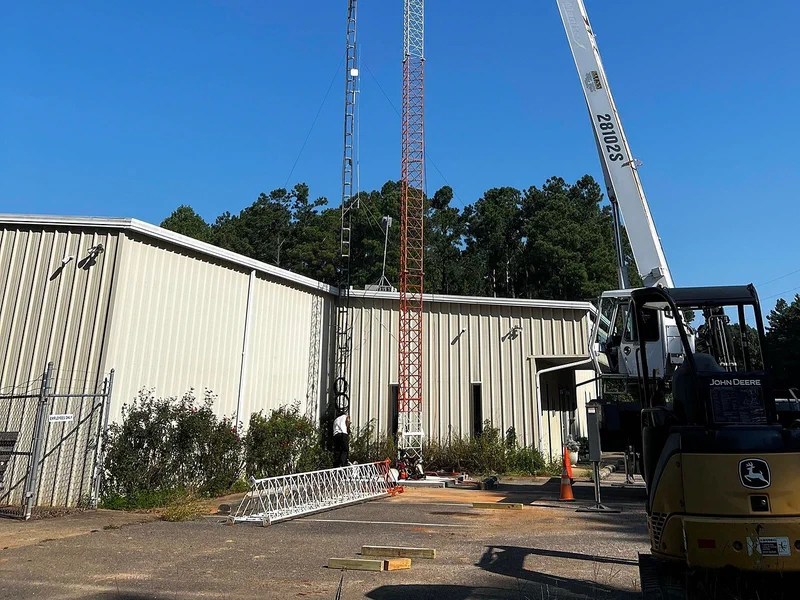
Tower Modifications
Antenna swaps, feed-line replacement, load-bearing upgrades.
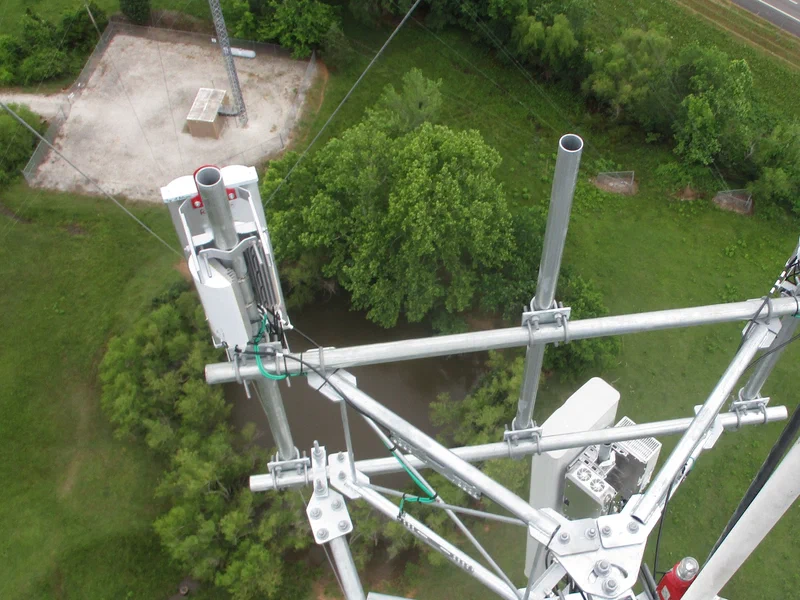
Maintenance & Inspection
Inspections, repairs, and post-storm response for a 20-year asset.
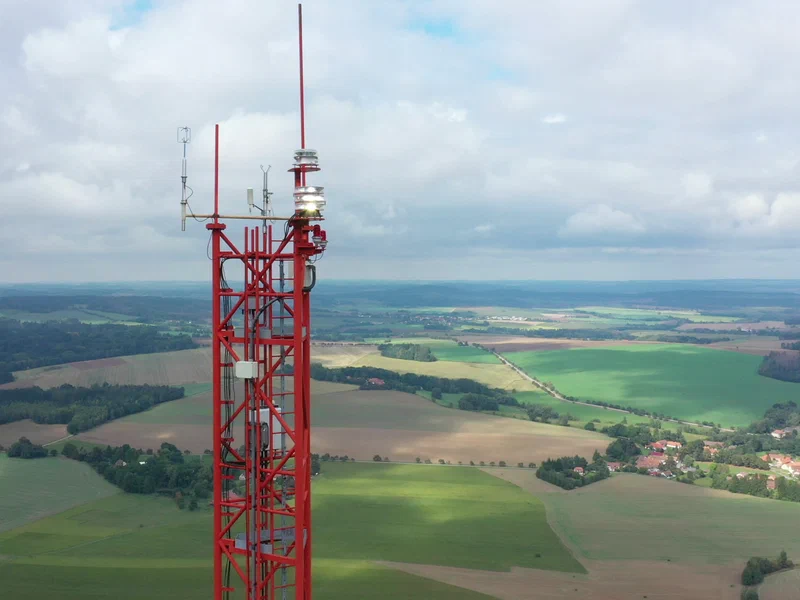
Obstruction Lighting
FAA-compliant beacon, strobe, and side-light repairs. Bulb and LED replacement.
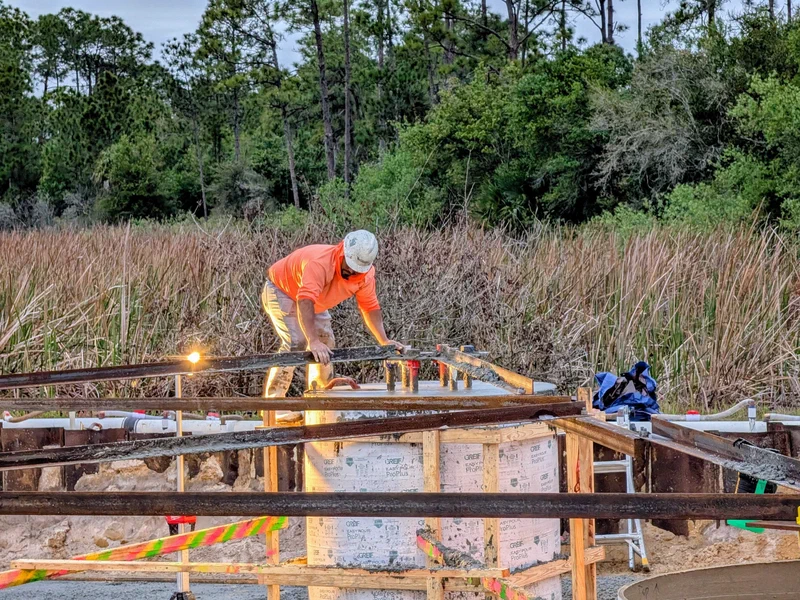
Foundations & Civil
Excavation, rebar, concrete, grading, fencing, and ground rings.
Tower Erection
Guyed, self-supporting, and monopole structures up to 300ft.
Page last updated August 21, 2026.
Tell us the site.
We'll bring the steel.
Send the location, tower type, scope, and timeline. We come back with a quote, a crew, and a schedule you can build a business around.